
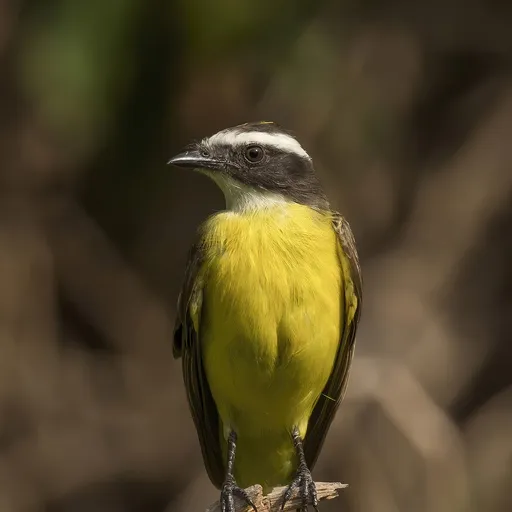
Rusty-margined Flycatcher
Myiozetetes cayanensis
Least Concern
Listen
XC248259 · Niels Krabbe · Esmeraldas: 7 km WNW Lita, Ecuador · CC BY-SA 4.0
Overview
The rusty-margined flycatcher (Myiozetetes cayanensis) is a species of bird in the tyrant flycatcher family, Tyrannidae. It is distributed across Panama and most mainland South American countries, with occasional vagrancies to Costa Rica and Argentina. Classified as Least Concern by the IUCN, it maintains a stable population of at least fifty million mature individuals.
Identification
- Measures 16.5 to 18 cm in length and weighs between 22 and 29.5 g, with a stubby black bill and black legs.
- Exhibits a dark sooty brown to blackish-brown crown with a mostly hidden bright yellow to golden-orange patch in the centre, and a white supercilium extending far past the eye.
- Features plain brown to olive-brown upperparts and bright yellow underparts, with wings showing thin rusty or cinnamon-rufous edges on the outer secondaries and inner primaries.
- Dawn song consists of a repeated fwee, often with a short couplet, while common calls include a thin, whining peeeeeeeea or wheeeeee.
Habitat
This species inhabits partially open landscapes such as cultivated areas, clearings, pastures with shrubs, and gallery forests, often favouring locations near water. In the Amazon Basin, it is also found along rivers and oxbow lakes, and it may occur in ranches, parks, and gardens but tends to avoid close proximity to human habitations. Its elevation range varies geographically, extending from sea level up to 2,000 m in Colombia and 1,900 m north of the Orinoco River in Venezuela.
Diet
The bird feeds primarily on insects, occasionally supplementing its diet with small fruits. It usually forages in pairs or small groups, perching in open areas to take prey via sallies to the ground or vegetation, and by hawking in mid-air, often over water. Fruits are typically consumed by gleaning or snatching while briefly hovering.
Did you know?
The species was first described by French zoologist Mathurin Jacques Brisson in 1760 based on a specimen collected in Cayenne, French Guiana, using the French name Le gobe-mouche de Cayenne before the binomial name Muscicapa cayanensis was assigned by Linnaeus in 1766.
Sources
- Wikipedia · CC BY-SA 4.0
- Wikidata · CC0 1.0