
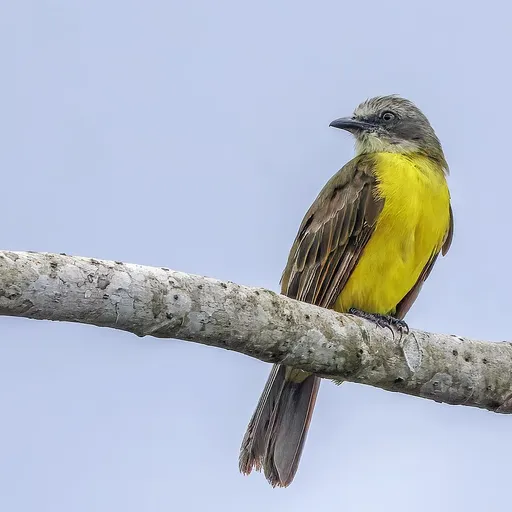
Grey-capped Flycatcher
Myiozetetes granadensis
Least Concern
Listen
XC249453 · Niels Krabbe · Napo: 1 km S Puerto Napo, Ecuador · CC BY-SA 4.0
Overview
The grey-capped flycatcher (Myiozetetes granadensis) is a passerine bird belonging to the tyrant flycatcher family, Tyrannidae. It is a resident species found across parts of Central and South America and is classified as Least Concern by the IUCN, with a stable population of at least five million mature individuals.
Identification
- Length of 16 to 18 cm with bright yellow underparts that have a slight olive tinge on the sides of the breast.
- White forehead extending as a thin supercilium to just past the eye, with dusky lores and ear coverts.
- Adult males of the nominate subspecies display a grey crown with a mostly hidden orange-yellow to reddish-orange central patch, which may be smaller or absent in females.
- Distinctive vocalisations include dawn songs like "kip, ki[p, kip, keeuw-kreh" in western Ecuador and a high "djup-djup sréeeh" in Central America.
Habitat
The species inhabits a variety of humid, somewhat open landscapes in tropical and lower subtropical zones, including forest edges, shrubby clearings, secondary forest, and agricultural areas with scattered trees. It is found in a disjunct distribution across Bolivia, Brazil, Colombia, Costa Rica, Ecuador, Honduras, Nicaragua, Panama, Peru, and Venezuela, typically at elevations ranging from sea level to 1,800 m.
Diet
The grey-capped flycatcher feeds mostly on insects, supplemented by berries and seeds, foraging singly, in pairs, or in small family groups. It captures insect prey primarily by hawking in mid-air, perching up to the forest's mid-level or in treetops, and occasionally making sallies to foliage.
Did you know?
Outside the breeding season, large numbers of grey-capped flycatchers may share a fruiting tree. Its breeding nests are bulky domed cups made of dry grass and straw, which can be placed as high as 18 m (60 ft) above the ground.
Sources
- Wikipedia · CC BY-SA 4.0
- Wikidata · CC0 1.0