
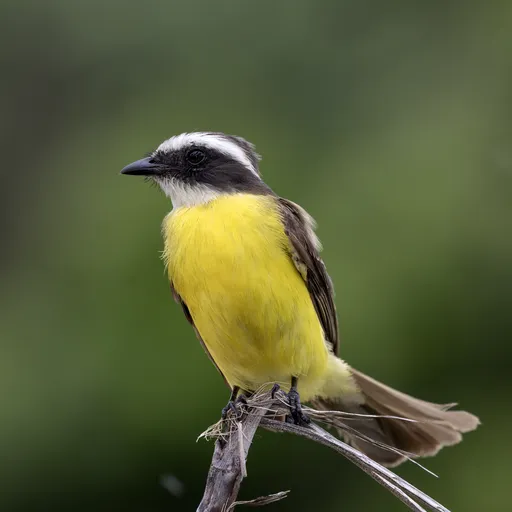
Social Flycatcher
Myiozetetes similis
Least Concern
Listen
XC249867 · Niels Krabbe · Pastaza: Kapawi area, left bank Río Pastaza, Ecuador · CC BY-SA 4.0
Overview
The social flycatcher (Myiozetetes similis) is a passerine bird belonging to the tyrant flycatcher family Tyrannidae. It is found across Mexico, Central America, and most of mainland South America, though it is absent from Chile, Guyana, Suriname, and Uruguay.
Identification
- A medium-sized bird measuring 16 to 18.5 cm in length with bright yellow underparts and a dark gray to brownish gray head.
- Features a wide white supercilium extending past the eye and a mostly hidden bright red to orangish red patch on the crown.
- Possesses a stubby black bill, brown iris, and black legs and feet, with upperparts that are dull olive-green to brownish olive.
- Produces a dawn song characterised by shrill notes repeated several times, often described as seeu, seeu, see-u-chú or sree, sree, sree si-si-chuhr.
Habitat
This species inhabits a variety of moist to semi-arid landscapes in tropical and lower subtropical zones, including lowlands with scattered trees, secondary forest, forest edges, gallery forests, and agricultural or residential areas. Its elevation range typically spans from sea level to around 1,850 m in Mexico and Central America, though it reaches higher altitudes in specific regions such as Costa Rica and Peru.
Diet
The social flycatcher feeds primarily on insects, but also consumes a significant amount of berries, fruits, and seeds, with occasional records of tadpoles in its diet. It forages in pairs or family groups, taking prey with sallies from perches to the ground or vegetation and hawking in mid-air, though it rarely joins mixed-species feeding flocks.
Did you know?
In eastern Brazil, this flycatcher has been observed foraging peacefully near common marmosets in the undergrowth, potentially cooperating with the monkeys to flush prey from hiding during the dry season when fruits are scarce.
Sources
- Wikipedia · CC BY-SA 4.0
- Wikidata · CC0 1.0