
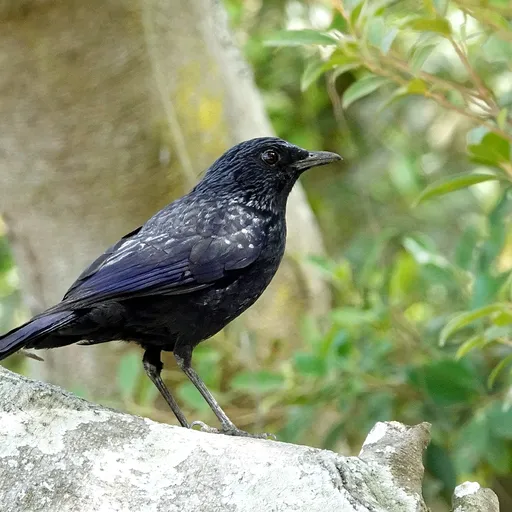
Blue Whistling Thrush
Myophonus caeruleus
Least Concern
Overview
The blue whistling thrush (Myophonus caeruleus) is a large bird in the Old World flycatcher family, known for its loud, human-like whistling song at dawn and dusk. Found across mountains in Central Asia, South Asia, China and Southeast Asia, it is the largest species in the Muscicapidae family and is classified as Least Concern by the IUCN Red List.
Identification
- Plumed in dark violet blue with shiny pale blue to white spangling on the tips of body feathers, except on the lores, abdomen and under the tail.
- Measures 29–35 cm in length and is approximately twice the weight of a common blackbird, with sizes varying by region according to Bergmann's rule.
- The bill is black in the nominate subspecies but yellow in others, while legs are black across all subspecies.
- Distinctive for its loud, human-like whistling song, particularly active at dawn and dusk.
Habitat
Occupies temperate forests and subtropical or tropical moist montane forests along the Tian Shan and Himalayas. The species ranges across numerous countries including Afghanistan, China, India and Indonesia, often making altitudinal movements and descending in winter in the Himalayas. In northern China, such as the Beijing area, it is a summer visitor that migrates away during the winter.
Diet
Forages on the ground, often along streams and in damp places, feeding on snails, crabs, insects and fruit. The bird turns over leaves and small stones to locate prey, which it often batters on a rock before eating. In captivity, they have been known to kill and eat mice, and in the wild they have been recorded preying on small birds.
Did you know?
In captivity, blue whistling thrushes have been known to kill and eat mice, and in the wild they have even been recorded preying on small birds. Their call precedes sunrise the most during November, often sounding distinct from other birds during the darkness of dawn and dusk.
Sources
- Wikipedia · CC BY-SA 4.0
- Wikidata · CC0 1.0