
Malabar Whistling Thrush
Myophonus horsfieldii
Least Concern
Listen
XC875445 · Jairam Vijayan · Payyavoor, Kannur, Kerala, India · CC BY-SA 4.0
Overview
The Malabar whistling thrush (Myophonus horsfieldii) is a large thrush species within the family Muscicapidae. It is a resident bird found in peninsular India, known for its metallic blue plumage and human-like whistling calls.
Identification
- Large thrush measuring 25–30 cm in length with a weight of 101–130 g.
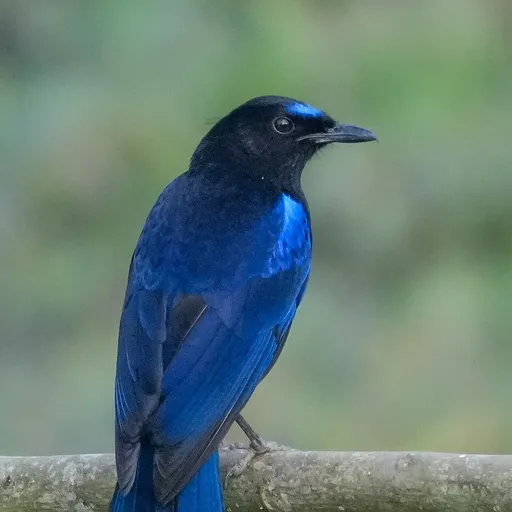
- Male exhibits a blackish upper body with shiny metallic blue patches on the forehead and shoulders, and glossy royal-blue scaling on the back and belly; the blue is visible only in oblique lighting due to ultraviolet reflectance.
- Females resemble males but display weaker scaling on the underparts.
- Bill and legs are black; juveniles are black with a glossy blue shoulder patch and wing edgings.
Habitat
This species inhabits dark undergrowth in dense riverine forests, foraging in rocky hill streams, secondary growth, and plantations from foothills up to 2,200 m altitude. It is distributed along the Western Ghats south of the Surat Dangs, the Satpura range to Chhattisgarh, and locally in the Eastern Ghats.
Diet
An omnivore that feeds primarily on insects, snails, worms, crabs, and small frogs, supplemented by drupes, wind-fallen figs, and berries. Occasionally, it has been recorded consuming small snakes, including the rat snake.
Did you know?
The bird has historically been called the 'whistling schoolboy' due to its dawn calls, which possess a very human quality. It was also once popular as a cage bird because of its ability to learn entire tunes.
Sources
- Wikipedia · CC BY-SA 4.0
- Wikidata · CC0 1.0