
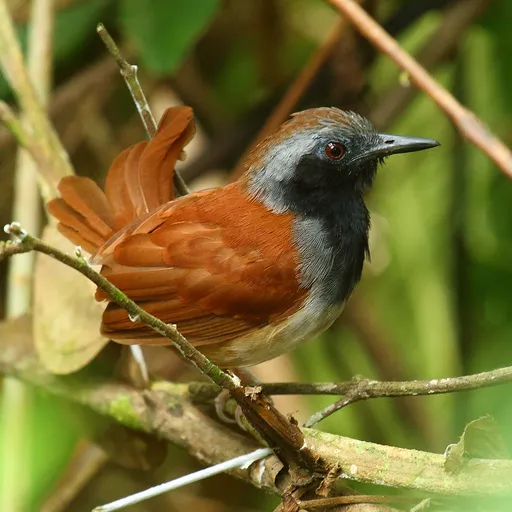
White-bellied Antbird
Myrmeciza longipes
Least Concern
Overview
The white-bellied antbird (Myrmeciza longipes) is a passerine bird in the family Thamnophilidae, known as the 'typical antbirds'. Also referred to as Swainson's antcatcher in historical sources, it is currently the only member of its genus following recent taxonomic rearrangements. The species is classified as Least Concern by the IUCN, though its population is believed to be decreasing.
Identification
- Approximately 15 cm in length with pinkish gray legs and feet.
- Adult males of the nominate subspecies have cinnamon rufous upperparts, black head and upper breast bordered with slate gray, and a white belly; females are similar but have darker brown head sides and ochraceous buff throat and upper breast.
- The male song is described as a bright, ringing crescendo of 15-25 loud, rapid jeer notes that descend, trail off, and end in a few chew notes on the same pitch.
Habitat
Found across Panama, Trinidad, and northern South America, the white-bellied antbird primarily inhabits the floor and understorey of moderately humid semi-deciduous forest. It also occurs in deciduous forest, small tracts of more humid rainforest, gallery forest, and shrubby secondary forest. Elevations vary by region, reaching up to 1,800 m in Colombia and 1,300 m in Venezuela.
Diet
The bird feeds on a variety of insects and probably spiders, foraging in dense vegetation on the ground and up to 1 m above it. It captures prey by tossing aside and picking from leaf litter, gleaning from vegetation, or jumping to the underside of overhanging branches. While it regularly follows army ant swarms, it is not dependent on them and seldom joins mixed-species feeding flocks.
Did you know?
Despite its scientific name Myrmeciza longipes deriving from Greek roots meaning 'ant ambusher' with 'long foot', the species is not an obligate army ant follower, does not specialize in eating ants, and does not possess unusually long legs.
Sources
- Wikipedia · CC BY-SA 4.0
- Wikidata · CC0 1.0