
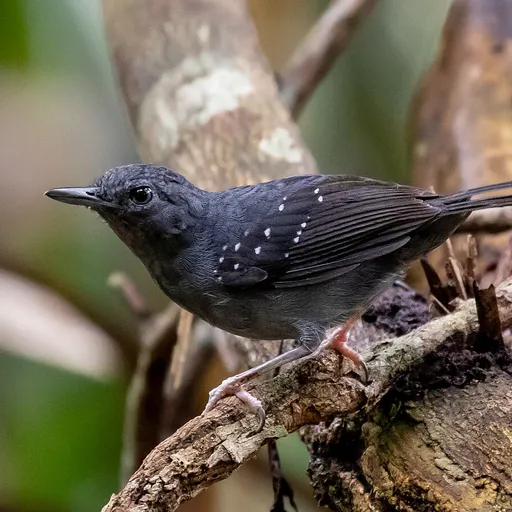
Humaita Antbird
Myrmelastes humaythae
Least Concern
Overview
The Humaita antbird (Myrmelastes humaythae) is a species of passerine bird belonging to the typical antbirds. It is found in western Amazonian Brazil, eastern Peru, and northern Bolivia, where it is assessed as a species of Least Concern.
Identification
- Length is 14 to 16 cm, with pink legs and feet in both sexes.
- Males possess medium gray upperparts with an olive-brown tinge and blackish gray wings and tails featuring wide white tips on the wing coverts.
- Females have a brown crown and upperparts, with blackish brown wings and tails that have pale cinnamon-rufous tips on the wing coverts.
- The song consists of a long trill that rises in pitch, with a pace that increases at the start, remains steady in the middle, and decreases at the end.
Habitat
It primarily inhabits the floor and understorey of terra firme evergreen forest, favouring poorly drained areas and locations along small watercourses. Its range covers western Amazonian Brazil between the lower Japurá and lower Negro rivers north of the Amazon and east to the Madeira River south of the Amazon, as well as the Madre de Dios and Pando Departments in Peru and Bolivia.
Diet
The diet and foraging behaviour of the Humaita antbird are not known but are assumed to be very similar or identical to those of its former parent species, the spot-winged antbird.
Did you know?
The species was elevated to full species status only in 2007, following a study of vocal characteristics that revealed significant differences between it and the spot-winged antbird, from which it had previously been considered a subspecies.
Sources
- Wikipedia · CC BY-SA 4.0
- Wikidata · CC0 1.0