
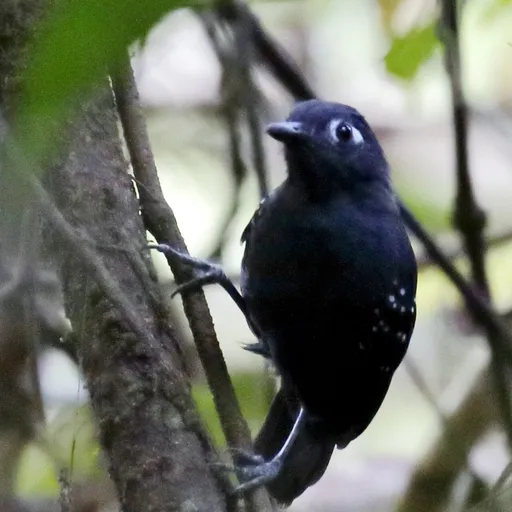
Plumbeous Antbird
Myrmelastes hyperythrus
Least Concern
Listen
XC248752 · Niels Krabbe · Sucumbíos: 'La Selva Jungle Lodge', n bank Río Napo, Ecuador · CC BY-SA 4.0
Overview
The plumbeous antbird (Myrmelastes hyperythrus) is a monotypic species of bird belonging to the family Thamnophilidae. It is currently assessed as a species of Least Concern by the IUCN, with a stable population and no immediate threats identified.
Identification
- Length of 17 to 18 cm with a weight of 38 to 44 g.
- Males are mostly dark slaty grey, featuring blackish grey wings and tails with white spots at the tips of the wing coverts, and a large area of bare light blue skin around the eye.
- Females share the dark slaty grey upperparts but possess bright rufous underparts, with a brown tinge on the flanks and crissum.
- Song consists of a long, accelerating rattling trill that gains and then declines in intensity, transcribed as 'wo-wu-wu-wu-wu-wu-wu-wrrrrrrrrrr'.
Habitat
Found in the western Amazon Basin, ranging from southern Colombia and northeastern Ecuador through eastern Peru into northwestern Bolivia and eastern Brazil to the Purus River basin. It inhabits the floor and understorey of evergreen forest, favouring the interior of várzea where tree falls create openings, as well as transitional forests and small watercourses. Elevation typically ranges from below 500 m in Colombia and Peru to 300 m in Ecuador, though it can reach 800 m locally in Peru.
Diet
The diet includes insects, other arthropods, and snails, with foraging conducted by individuals, pairs, or small family groups. Foraging occurs mostly within about 3 m of the ground, away from mixed-species flocks, by hopping along the ground and low branches to pick prey from leaf litter or reaching to leaves and twigs. The bird occasionally attends army ant swarms to capture prey disturbed by the ants.
Did you know?
Nests are constructed from black rhizomorphs or rootlets and covered in dry leaves attached with spider silk, suspended about 1 m above the ground. The first nests were described only in 2003 based on specimens found in Manú National Park, Peru, and in Brazil.
Sources
- Wikipedia · CC BY-SA 4.0
- Wikidata · CC0 1.0