
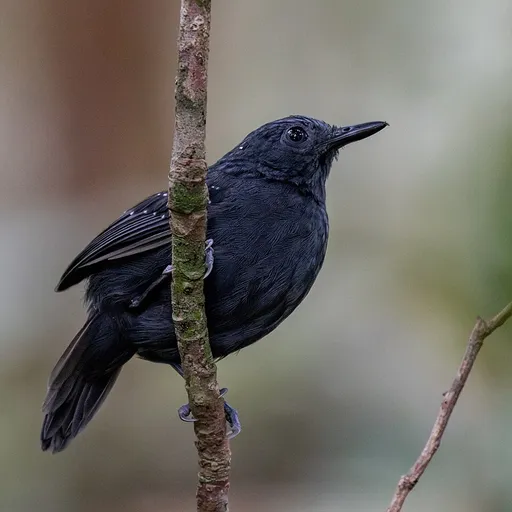
Slate-colored Antbird
Myrmelastes schistaceus
Least Concern
Overview
The slate-colored antbird (Myrmelastes schistaceus) is a species of bird in the family Thamnophilidae, commonly known as the typical antbirds. It is a year-round resident found in the lowlands of the western Amazon Basin across Brazil, Colombia, Ecuador, and Peru. Although its population is believed to be decreasing, it is currently assessed as being of Least Concern on the IUCN Red List.
Identification
- Males are mostly dark bluish or slate gray with blackish gray wings and tails featuring small white spots at the tips of the wing coverts, and they possess a black bill.
- Females display a dark chestnut crown with thin rufous streaks, an olive brown back, and orangish rufous underparts, with a gray maxilla and black mandible.
- The species measures 14.5 to 15.5 cm in length and has a song described as a simple series of penetrating, semi-musical notes ('peeyr-peeyr') or slow, accelerating rising whistles.
- Both sexes share a gray iris and leaden to bluish gray legs and feet.
Habitat
The slate-colored antbird inhabits the understory of terra firme forest in the lowlands of the western Amazon Basin. Its range covers southern Colombia, far northeastern Ecuador, northeastern to east-central Peru, and western Brazil east to central Amazonas state. Elevation ranges up to 250 m in Ecuador and 400 m in Colombia.
Diet
The diet includes insects and the bird forages as individuals, pairs, or small family groups, primarily within about 1 m of the ground. It hops along the ground and low branches, picking prey from leaf litter or reaching out from a low perch, and occasionally attends army ant swarms to capture disturbed prey.
Did you know?
The species has a complicated taxonomic history, having been described by Philip Sclater in 1858 as Hypnocmenis schistacea and subsequently placed in several other genera before its finalisation in Myrmelastes in 2013. It is suspected to be particularly vulnerable to habitat loss as it avoids second-growth or disturbed forests.
Sources
- Wikipedia · CC BY-SA 4.0
- Wikidata · CC0 1.0