
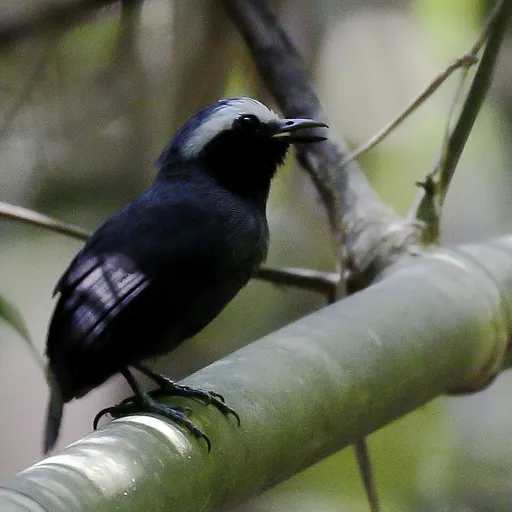
White-browed Antbird
Myrmoborus leucophrys
Least Concern
Listen
XC251226 · Niels Krabbe · Zamora-Chinchipe: 'Cabañas Yankuam' 2 km S Las Orchideas, Nangaritza Valley, Ecuador · CC BY-SA 4.0
Overview
The white-browed antbird (Myrmoborus leucophrys) is a perching bird in the family Thamnophilidae, classified as a species of 'typical antbirds'. It holds a Least Concern status on the IUCN Red List and is found across every mainland South American country except Argentina, Chile, Paraguay, and Uruguay.
Identification
- Adult males of the nominate subspecies feature a white forehead and supercilium, with mostly dark bluish-gray plumage that is darkest on the wings and tail, and a black face, chin, and throat.
- Adult females have a cinnamon to yellow-buff forehead and supercilium, an olive-brown crown with a reddish tinge, and white underparts with blackish-gray sides.
- The species measures 12 to 13.5 cm in length and weighs between 18 and 22 g.
- The male's song is a long trill, typically lasting around four seconds, that increases in intensity and pace initially before dropping slightly in pitch at the end.
Habitat
The species inhabits the northern and southern Amazon Basin and the Guianan Shield, though it is absent from a large central area of Amazonia. In the Amazon Basin, it typically occurs near water, utilizing várzea and transitional forests, while in other regions it uses similar habitats on Andean slopes and forest edges. Elevation ranges vary by region, reaching up to 1,400 m in Peru and 1,100 m in Ecuador.
Diet
The white-browed antbird feeds on a wide variety of insects and spiders, typically foraging singly, in pairs, or in small family groups. It forages mostly on the ground or within about 1 m of it, hopping and making short flights while bobbing its tail to capture prey by gleaning, jumping, and lunging. It regularly attends army ant swarms to catch fleeing prey but is subordinate to obligate ant-followers.
Did you know?
The species has a curious distribution that includes the northern and southern Amazon Basin but excludes a large area of Amazonia between them. Although the bird's breeding season has not been fully defined, the one known nest found in Peru was constructed from bamboo leaves and placed on the ground.
Sources
- Wikipedia · CC BY-SA 4.0
- Wikidata · CC0 1.0