
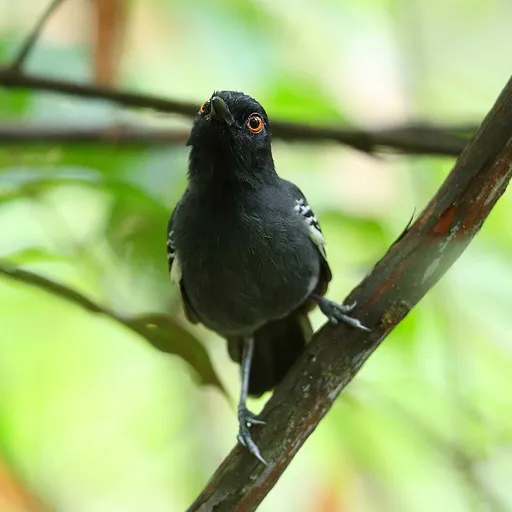
Black-tailed Antbird
Myrmoborus melanurus
Near Threatened
Overview
The Myrmoborus melanurus, commonly known as the black-tailed antbird, is a Near Threatened species belonging to the family Thamnophilidae. It is a year-round resident found exclusively in the far western Amazon Basin of Peru, Brazil, and Colombia.
Identification
- Small bird measuring 12 to 13 cm in length with an average weight of about 18 g.
- Adult males are mostly very dark gray with blackish heads, necks, and wing coverts featuring narrow white tips; females possess a dull reddish brown crown and medium brown back.
- Both sexes exhibit a red iris and blue-gray to gray legs, with males having entirely black bills and females displaying a black maxilla and gray mandible.
- Song consists of a moderately paced, descending series of slightly burry notes described as 'djee DJEE-djee-djee', while the call is a sharp 'tchew' note that may be doubled.
Habitat
Found in the far western Amazon Basin across Peru, Brazil, and Colombia, specifically within seasonally flooded varzea forest along waterways and oxbow lakes. The species favours dense thickets of vines and other vegetation near the water at elevations between 100 and 250 m above sea level.
Diet
Feeds primarily on insects, though the specific composition of its diet is not known in detail. It typically forages in pairs within dense vegetation, hopping between feeding stops on or near the ground, and does not join mixed-species feeding flocks.
Did you know?
Despite being named the black-tailed antbird, its tail feathers are actually described as dusky with medium brown edges rather than black. The bird constructs a globe-shaped nest made of dried leaves on the ground, with its full breeding season remaining largely unknown aside from activity in July.
Sources
- Wikipedia · CC BY-SA 4.0
- Wikidata · CC0 1.0