
Black-faced Antbird
Myrmoborus myotherinus
Least Concern
Listen
XC248892 · Niels Krabbe · Napo: Payamino, Loreto-Coca road, Ecuador · CC BY-SA 4.0
Overview
The black-faced antbird (Myrmoborus myotherinus) is a small passerine bird belonging to the subfamily Thamnophilinae. It is found across much of the Amazon Basin, spanning six South American countries, and is currently assessed as a species of Least Concern.
Identification
- Size 12–13.5 cm in length; weight 16–22 g.
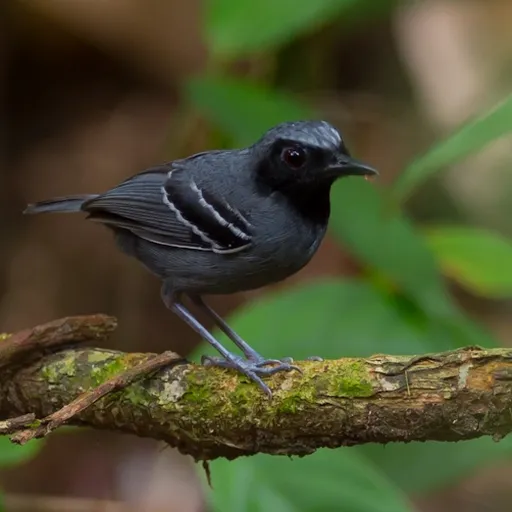
- Males exhibit dark bluish grey upperparts with a white patch between the scapulars, black face with a pale supercilium, and pale grey underparts.
- Females have dark greyish olive-brown upperparts, blackish faces, white throats with small black spots, and light buff underparts with an olive tinge.
- Both sexes possess deep red irises; the song consists of a countable series of evenly spaced, frequency-modulated notes transcribed as "zree-zree-zree-zrut-zrut".
Habitat
Occupying much of the Amazon Basin, the species primarily inhabits the understorey of terra firme evergreen forest, though it also uses mature secondary woodland and transitional forest. It favours dense vegetation in gaps such as those formed by fallen trees and is found at elevations ranging from below 700 m in Ecuador to 1,250 m in Peru.
Diet
The diet comprises insects and spiders, which are captured by gleaning, jumping, and lunging from perches or dropping to the ground. Foraging is typically conducted singly, in pairs, or in small family groups close to the ground, and the bird regularly attends army ant swarms to capture fleeing prey, despite being subordinate to obligate ant-followers.
Did you know?
To protect their young from predators, one of the parents performs a broken-wing display to distract attention away from the ground nest. The nest itself is an inconspicuous dome constructed of four layers, including fine palm fibres and dry leaves, making it very difficult to see.
Sources
- Wikipedia · CC BY-SA 4.0
- Wikidata · CC0 1.0