
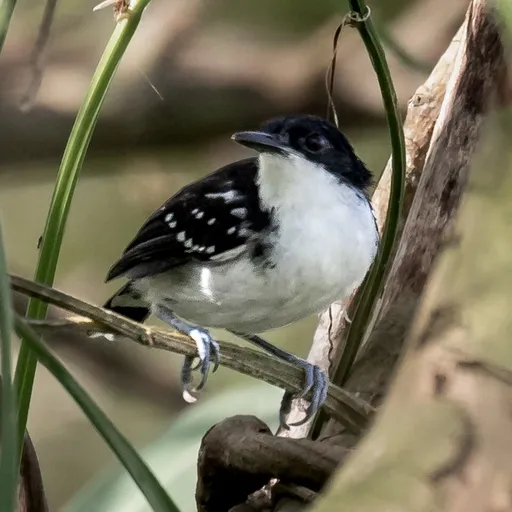
Black-and-white Antbird
Myrmochanes hemileucus
Least Concern
Listen
XC248777 · Niels Krabbe · Orellana: river island at Añangu, Ecuador · CC BY-SA 4.0
Overview
The black-and-white antbird (Myrmochanes hemileucus) is a species of bird in the subfamily Thamnophilinae of family Thamnophilidae, known as the typical antbirds. It is the only member of its genus and is classified as Least Concern by the IUCN due to its large range and stable population.
Identification
- Length 10 to 12.2 cm, weighing 12 to 13 g.
- Adult males have black faces, crowns, napes, and upperparts, with a mostly hidden white patch between the shoulders; wings are black with sparse white tips on the coverts.
- Tail is short, somewhat graduated, and black with white tips; throat and underparts are white, often with buff on the flanks and belly.
- Long, slender black bill; brown iris; gray legs and feet. Female resembles male but has white spots on the lores and a buffier belly and undertail coverts.
- Song is an accelerating, descending series of hollow, piping notes: 'PU-pu-pu'pu'puprrrrr', often sung as a duet with the female’s voice higher-pitched. Calls include 'pu pu pu', a rapid musical rattle, a single 'peu', and a bisyllabic 'tuk-et'.
Habitat
Found in the western Amazon Basin along the Amazon from its origin in Peru to the mouth of the Rio Madeira in Brazil, and along its major tributaries, including the Rio Napo, Rios Ucayali and Marañón in Peru, and the Rio Madeira through central Bolivia and Brazil. Far southern Colombia is also part of its range, along the Amazon where it forms the border with Peru. Almost exclusively found on river islands, though occasionally in agricultural plots on the mainland, favouring young to middle-aged islands with Tessaria scrub and vine tangles in the understory of tall Cecropia forest.
Diet
Diet includes insects and probably spiders. Forages in pairs or family groups, less often singly, and never in mixed-species feeding flocks. Mostly forages in vine tangles and vegetation in the understory of Cecropia woods, between 1 and 4 m from the ground, occasionally up to 8 m. Prey is mostly gleaned from leaves, bark, and grass blades, with active foraging through lunges and short sallies from perches.
Did you know?
Despite its restricted habitat on river islands, the black-and-white antbird shows surprising adaptability by occasionally foraging in agricultural plots on the mainland. Its song is often performed as a duet, with the female’s voice notably higher-pitched than the male’s.
Sources
- Wikipedia · CC BY-SA 4.0
- Wikidata · CC0 1.0