
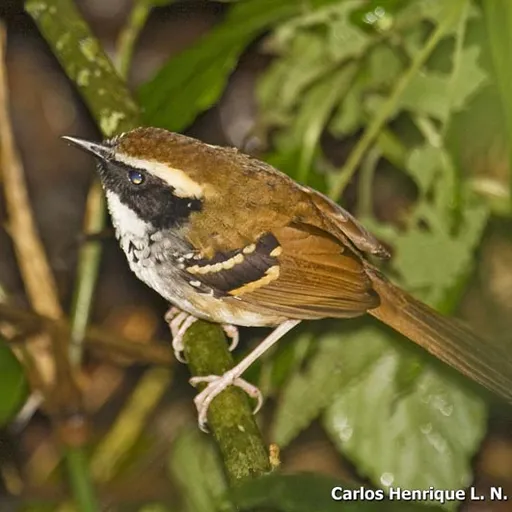
White-bibbed Antbird
Myrmoderus loricatus
Least Concern
Overview
The white-bibbed antbird (Myrmoderus loricatus) is a species of passerine bird in the family Thamnophilidae, commonly known as the typical antbirds. It is endemic to eastern Brazil and is currently assessed as Least Concern on the IUCN Red List.
Identification
- Males possess a black crown with wide rufous-chestnut feather edges, a long white supercilium on a black face, and rufous-chestnut upperparts with a white patch between the scapulars.
- Females resemble males but feature a dark reddish yellow-brown crown, a pale buff supercilium, and mostly plain white underparts.
- Adults measure 14 to 15 cm in length and display a long white supercilium contrasting with a black face.
- The song consists of an extremely high, descending, rapid series of 3-5 whispered, sawing double 'siweesiwee-see' notes.
Habitat
Found in eastern Brazil from central and southeastern Bahia south into northeastern São Paulo state, this species inhabits the floor of evergreen forest and nearby mature secondary forest. It favours areas with many saplings and a dense herbaceous understorey at elevations between 700 and 1,300 m.
Diet
The diet includes insects and probably spiders, though it has not been fully detailed. Individuals, pairs, and family groups forage mostly on the ground and in low vegetation up to about 1 m, actively hopping through vine tangles and brushing to probe leaf litter and glean from low-hanging leaves.
Did you know?
Although they rarely join mixed-species feeding flocks, white-bibbed antbirds will occasionally and briefly attend army ant swarms. They construct simple bowl nests from dead leaves and plant fibres placed on or near the ground.
Sources
- Wikipedia · CC BY-SA 4.0
- Wikidata · CC0 1.0