
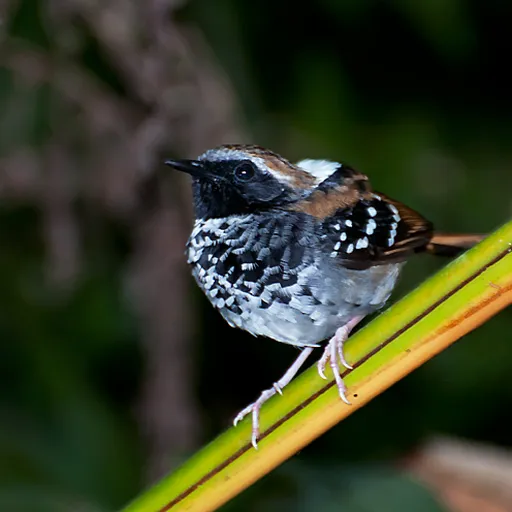
Squamate Antbird
Myrmoderus squamosus
Least Concern
Overview
The squamate antbird (Myrmoderus squamosus) is a species of bird in the family Thamnophilidae, known as the typical antbirds. It is endemic to Brazil, where it is considered fairly common and assessed as being of Least Concern on the IUCN Red List.
Identification
- Length of 14 to 15 cm with a weight of 16.5 to 20 g.
- Adult males feature a dark yellowish brown crown and upperparts with a white patch between the scapulars, a long gray-tinged white supercilium on a mostly black face, and a white belly with ochre-brown flanks.
- Adult females have paler upperparts, a white throat with faint gray bars, plain white underparts, and olive-brown flanks.
- Song consists of a countable series of doublets that start at a higher frequency and descend in pitch; calls include a short rattle and a short downslurred note.
Habitat
Found in eastern Brazil from southern São Paulo state to northern Rio Grande do Sul, with a record in Iguaçu National Park. The species inhabits the floor of evergreen and mature secondary forests, as well as restinga woodland on sandy soil near the coast, favouring areas with saplings and dense herbaceous understorey from sea level to 1,000 m.
Diet
Feeds on insects, spiders, other arthropods, and small snails. Foraging is conducted mostly on the ground by individuals, pairs, and family groups who hop actively through vine tangles, probe leaf litter, and glean from low-hanging leaves.
Did you know?
The squamate antbird has only once been observed attending an army ant swarm, which is uncommon behaviour for a member of the antbird family.
Sources
- Wikipedia · CC BY-SA 4.0
- Wikidata · CC0 1.0