
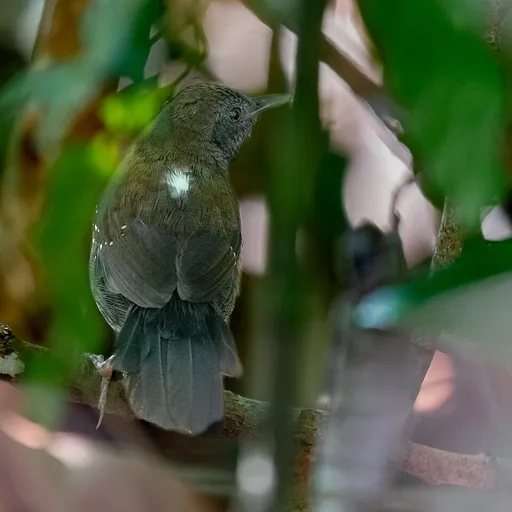
Black-throated Antbird
Myrmophylax atrothorax
Least Concern
Listen
XC249458 · Niels Krabbe · Napo: 1 km S Puerto Napo, Ecuador · CC BY-SA 4.0
Overview
The black-throated antbird (Myrmophylax atrothorax) is a passerine bird in the family Thamnophilidae, classified as Least Concern on the IUCN Red List. It is the sole member of its genus and is found across parts of South America, including Bolivia, Brazil, and the Guianas.
Identification
- Size: 13 to 14 cm long, weighing 14 to 18 g.
- Plumage: Males of the nominate subspecies have a dark yellowish olive-brown crown and upperparts, black throat and breast, and gray underparts; females have a dull reddish yellow-brown upper body, white chin and upper throat, and cinnamon-rufous underparts with dark olive-brown flanks.
- Bill and Legs: Gray legs; specific bill details not provided.
- Song: A very high, slightly decelerating series of 4–8 sharp 'chee' notes, starting with a stuttered 'tutu' and rising in pitch.
Habitat
Inhabits lowland terra firme, transitional, várzea, and igapó evergreen forests, as well as forest edges, swampy river areas, and regrowing clearings. It also occupies savanna woodlands on white sand soils in some regions and associates with Gynerium cane and Guadua bamboo in Peru and Bolivia. Always found in the understorey layer.
Diet
Feeds on arthropods, particularly insects and spiders, foraging almost exclusively within 1 m (3 ft) of the ground, occasionally up to 3 m (10 ft). Gleans prey from live vegetation, branches, and vines, and probes leaf litter and curled dead leaves, typically without flipping them. Rarely joins mixed-species flocks or follows army ant swarms.
Did you know?
The generic name Myrmophylax is derived from the Ancient Greek murmos (ant) and phulax (watcher or observer), while the specific epithet atrothorax comes from the Latin ater (black) and thorax (breast). Its ability to thrive in a variety of secondary and edge habitats makes it less vulnerable to disturbance than most other thamnophilids.
Sources
- Wikipedia · CC BY-SA 4.0
- Wikidata · CC0 1.0