
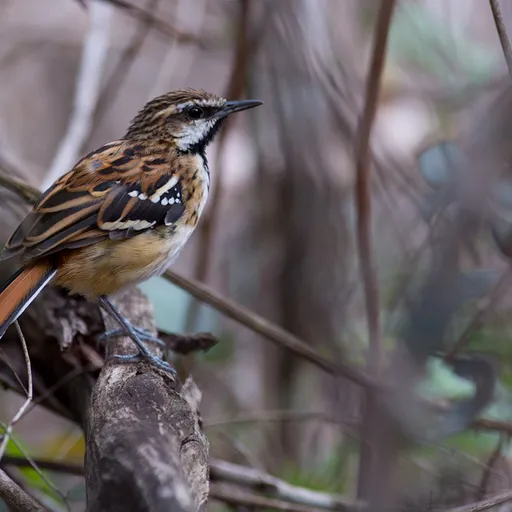
Stripe-backed Antbird
Myrmorchilus strigilatus
Least Concern
Overview
The stripe-backed antbird, Myrmorchilus strigilatus, is a species of bird in the family Thamnophilidae. It is a year-round resident found across Argentina, Bolivia, Brazil, and Paraguay. The species is assessed as Least Concern by the IUCN, though its population is believed to be decreasing.
Identification
- Length of 15 to 16 cm with a weight between 23 and 26 g.
- Adult males of the nominate subspecies feature a white supercilium, a dark line through the eye, and a rufous crown, neck, and back marked with black streaks.
- Wings are black with rufous edges on the flight feathers and white-tipped coverts, while the central tail feathers are rufous and outer ones are black with white edges.
- Song includes a high, sharp 'sreet-soweét', sometimes followed by a descending 'sreet-sreet-sreet-sruw-sruw', and calls consist of a long whistle.
Habitat
The species has a disjunct distribution, with the nominate subspecies inhabiting caatinga woodlands and scrublands in northeastern Brazil, and the subspecies M. s. suspicax occupying woodlands and scrublands of the Gran Chaco in western Brazil, southeastern Bolivia, western Paraguay, and northern Argentina. In both ecozones, the bird favours areas with dense ground cover and ranges in elevation up to approximately 1,100 m.
Diet
The stripe-backed antbird feeds primarily on arthropods, especially insects. It typically forages singly or in pairs on the ground under dense vegetation, picking through leaf litter and terrestrial bromeliads, but may also glean from foliage, branches, and vines up to 2 m above the ground.
Did you know?
The two known nests of this species were open cups of dry grass on the ground, each containing two eggs, though little else is known about its breeding biology. The genus Myrmorchilus was erected by Robert Ridgway in 1909 and contains only this one species.
Sources
- Wikipedia · CC BY-SA 4.0
- Wikidata · CC0 1.0