
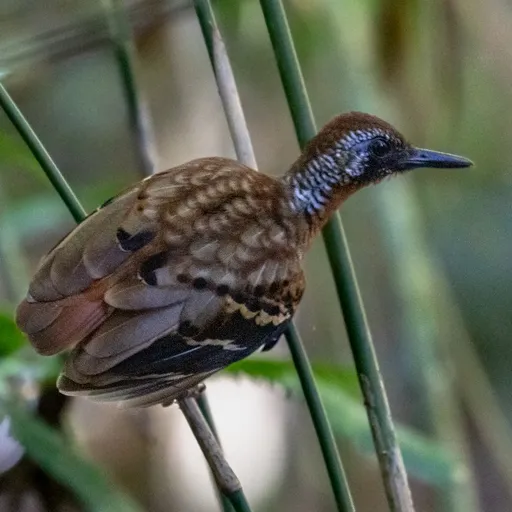
Wing-banded Antbird
Myrmornis torquata
Least Concern
Overview
The wing-banded antbird (Myrmornis torquata) is a passerine bird in the family Thamnophilidae, known for its distinctive plumage and ground-dwelling habits. Found across parts of Central and South America, it is classified as Least Concern on the IUCN Red List.
Identification
- Length 14.5 to 15.5 cm, with a short tail, short legs, and a 'dumpy' body.
- Sexes have different plumage: adult males have a black and white speckled face and neck sides, a reddish-brown crown and nape, and a black and white speckled band below the upper breast; females have paler upperparts and a cinnamon-rufous upper breast.
- Wings feature blackish-brown coverts with pale cinnamon buff tips and flight feathers with a pale cinnamon band on the primaries.
- Song consists of a series of 2-30 gradually rising, stressed, ringing 'weew' notes, with a nasal 'chirr' or 'churr' call.
Habitat
Inhabits humid lowland and foothill evergreen forest, often on terra firme and among hills, from sea level up to 1,250 m in Central America and typically up to 900 m in South America. It has a disjunct distribution across Central America and a broad range in South America, including Brazil, Colombia, Ecuador, and the Guianas.
Diet
Feeds mostly on arthropods and occasionally on small molluscs, foraging on the ground by hopping and flipping over leaf litter. It forages singly, in pairs, or in small family groups but does not join mixed-species feeding flocks or follow army ant swarms.
Did you know?
The species' scientific name torquata derives from the Latin for 'collared', referencing the distinct black and white speckled band across its upper breast.
Sources
- Wikipedia · CC BY-SA 4.0
- Wikidata · CC0 1.0