
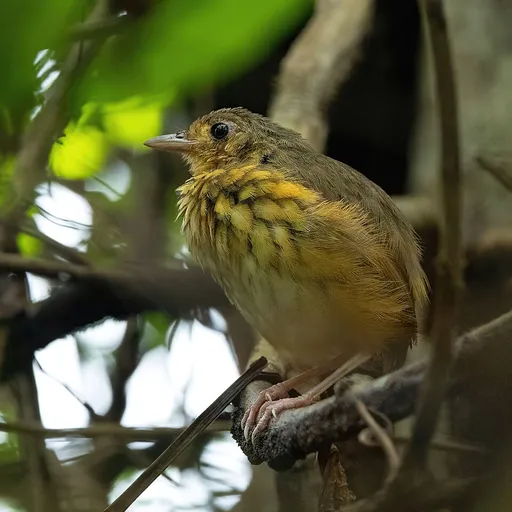
Amazonian Antpitta
Myrmothera berlepschi
Overview
The Amazonian antpitta (Myrmothera berlepschi) is a species of bird in the family Grallariidae found in Bolivia, Brazil, and Peru. It is a year-round resident of the Amazon Basin, where it inhabits the forest floor and dense undergrowth. The species is assessed as being of Least Concern by the IUCN.
Identification
- A small bird, 14.5 to 15 cm long, with olive-brown upperparts and a white throat.
- The breast and sides are buffy ochraceous with coarse dusky streaks, while the flanks and crissum are orange-rufous.
- Features include a buffy loral spot, pinkish-red bare skin around the eye, and bright pink legs.
- The song is described as a series of 3–5 deep, hollow hoots, while its call is a rapid series of hooting notes.
Habitat
This species occupies the Amazon Basin, ranging across Brazil, southeastern Peru, and north-central Bolivia. It inhabits the floor and dense undergrowth of riparian forest, mature secondary forest, and the edges of primary forest, typically occurring below 500 m elevation but reaching up to 700 m locally in Peru.
Diet
While the specific dietary details are not fully documented, its food is known to include insects. The bird usually forages singly, employing running, hopping, and walking movements on the forest floor and downed logs.
Did you know?
The bird was originally described in 1903 as Grallaria berlepschi and was later transferred to the genus Hylopezus before finally being placed in Myrmothera.