
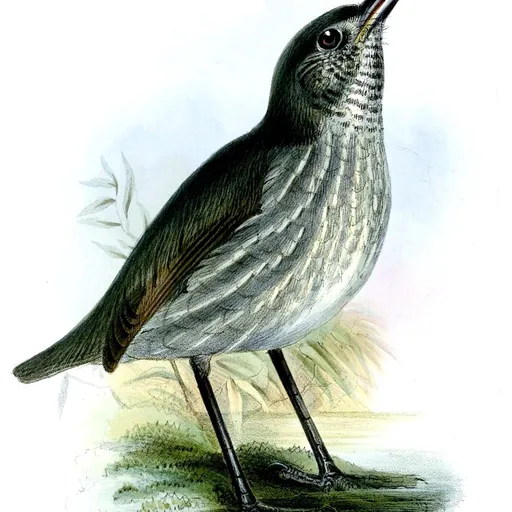
Thrush-like Antpitta
Myrmothera campanisona
Least Concern
Listen
XC249576 · Niels Krabbe · Pastaza: Churunalpi, 5 km N Canelos, Ecuador · CC BY-SA 4.0
Overview
The thrush-like antpitta (Myrmothera campanisona) is a species of bird in the antpitta family, Grallariidae, native to the Amazon basin. It is classified as a Least Concern species by the IUCN, although its population is believed to be decreasing due to indirect threats from deforestation.
Identification
- Approximately 14.5 to 15 cm long, with rufous-brown upperparts, a rufous-brown face, and white underparts with greyish-brown edges.
- The nominate subspecies features a small white spot behind the eye, while other subspecies appear more olive-brown.
- Possesses a dark brown iris, a black maxilla, and a pinkish-orange or pinkish-yellow mandible with a black tip, along with pale pink legs.
- Vocalises with a song of 4-6 hollow whistled notes described as 'whoh-whoh-whoh-whoh-whoh-whoh' or a low, rhythmically whistled wü-whoo, wü-whee-whee.
Habitat
Found throughout most of the Amazon Basin, this species inhabits humid rainforest in lowlands and foothills, primarily terra firme. It favours areas with dense understories, such as tree-fall openings, regrowing clearings, and edges along watercourses, occurring from sea level up to 1,500 m in parts of Peru.
Diet
The diet consists of insects and other arthropods, though it is not extensively detailed. The bird forages alone or in pairs by hopping and walking on the forest floor, fallen logs, and low branches, and has occasionally been observed attending army ant swarms.
Did you know?
The species' scientific name campanisona combines the Late Latin campana meaning 'bell' with the Latin sonus meaning 'sounding'.
Sources
- Wikipedia · CC BY-SA 4.0
- Wikidata · CC0 1.0