
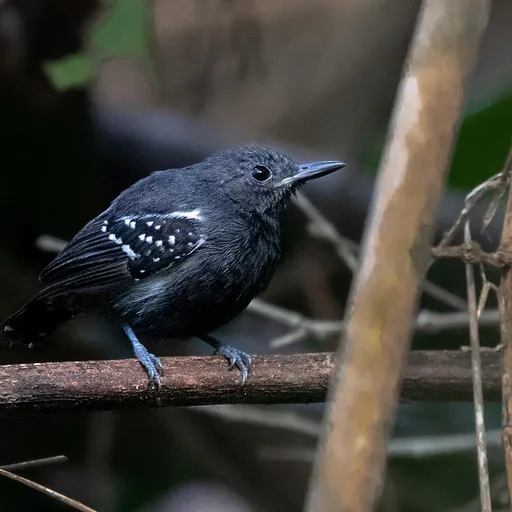
White-flanked Antwren
Myrmotherula axillaris
Least Concern
Listen
XC248418 · Niels Krabbe · Pichincha: Río Guaycuyacu, Ecuador · CC BY-SA 4.0
Overview
The white-flanked antwren, Myrmotherula axillaris, is a small bird in the typical antbird family found across Central and South America. It is a year-round resident that inhabits the understory and mid-story of various forest types, ranging from sea level to moderate altitudes.
Identification
- Small bird measuring 9 to 10.5 cm in length, weighing between 5 and 10.6 g, with a short tail.
- Males of the nominate subspecies have dark gray upperparts with a hidden white patch between the shoulders, blackish tails with white tips, and black throats and breasts contrasting with white flanks.
- Females display mottled pale olive-brown faces and olive-brown upperparts, with white throats and flanks, rich buff breasts, and olive-brown sides.
- Songs vary by subspecies, with some producing a rapid series of abrupt notes and others a countable series of whistles that drop in pitch but gain in intensity.
Habitat
Found from Honduras to Panama in Central America and across mainland South America excluding Argentina, Chile, Paraguay, and Uruguay, as well as on Trinidad. It inhabits the understorey and mid-storey of evergreen forests, including terra firme, várzea, and igapó types, as well as secondary woodland. The species occurs from sea level to about 1,100 m, with local variations in altitude limits across its range.
Diet
Feeds primarily on arthropods, including insects and spiders, foraging in dense vegetation between 2 and 12 m above the ground. It actively seeks prey by gleaning leaves, reaching into vine tangles, and lunging from perches, often as part of mixed-species feeding flocks. Occasionally follows army ant swarms, though only for short durations.
Did you know?
The nest of this antwren is a deep cup made of dead leaves and leaf skeletons, uniquely hung in a branch fork by fungal rhizomorphs. It is often concealed by overhanging leaves and placed up to 4 m above the ground in shrubs or small trees.
Sources
- Wikipedia · CC BY-SA 4.0
- Wikidata · CC0 1.0