
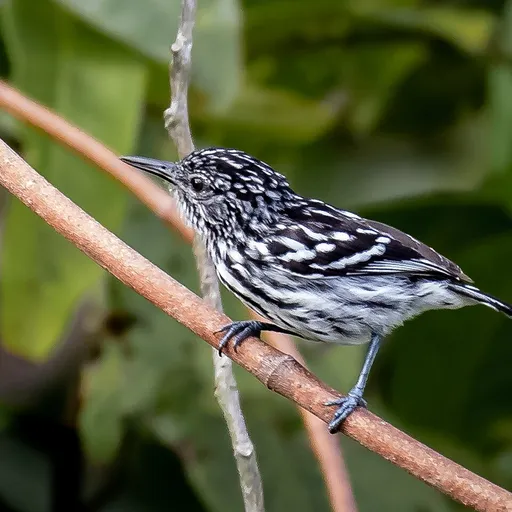
Cherrie's Antwren
Myrmotherula cherriei
Least Concern
Overview
Cherrie's antwren (Myrmotherula cherriei) is a species of bird in the family Thamnophilidae, commonly known as the typical antbirds. Found across parts of South America, it is classified by the IUCN as Least Concern, although its population is believed to be decreasing.
Identification
- Length of 9 to 10 cm with a tiny tail and a smallish body size.
- Adult males display a black and white streaked face, a black crown, back, and rump with white streaks, and a narrow white patch between the shoulders.
- Males have white throats, breasts, and bellies with black streaks extending to the grayer flanks and crissum.
- Adult females differ by having buff streaks on the head, lacking the white shoulder patch, and possessing pale buff underparts with thinner black streaks.
Habitat
The species has a disjunct distribution across southeastern Colombia, southwestern Venezuela, northeastern Peru, and the Rio Negro watersheds in Brazil. It inhabits the understorey and mid-storey of stunted shrubby woodlands on white-sand soil, as well as gallery forest in savannas and várzea. In specific areas such as Brazil and Peru, it favours thickets on islands, sandbars, and the edges of streams and lagoons.
Diet
Cherrie's antwren feeds primarily on arthropods, particularly insects and spiders. It typically forages singly or in pairs, often joining mixed-species feeding flocks. Foraging occurs mostly between 1 and 7 m above the ground in dense foliage, involving active gleaning by reaching, lunging, and making brief sallies from a perch.
Did you know?
The species is named in honour of George Cherrie, an American naturalist and adventurer who accompanied former US President Theodore Roosevelt on the famous 1913 exploration of the River of Doubt, which was later named Rio Roosevelt.
Sources
- Wikipedia · CC BY-SA 4.0
- Wikidata · CC0 1.0