
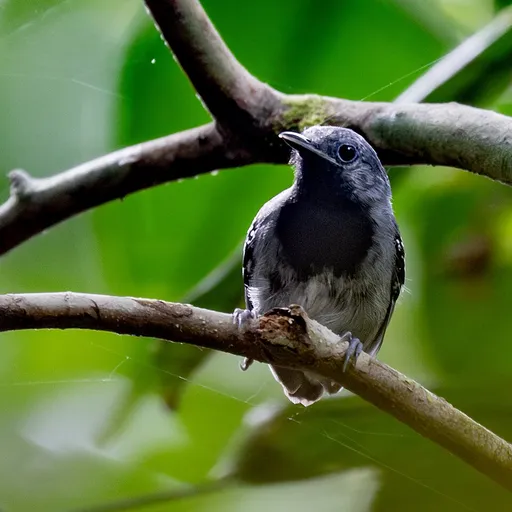
Ihering's Antwren
Myrmotherula iheringi
Least Concern
Overview
Ihering's antwren (Myrmotherula iheringi) is a species of bird in the family Thamnophilidae, commonly known as the typical antbirds. It is found in the western Amazon Basin across Bolivia, Brazil, and Peru, and is currently listed as Least Concern by the IUCN, though its population is believed to be decreasing.
Identification
- Length of 8.5 to 9.5 cm with a shortish tail.
- Adult males have dark gray upperparts with a hidden white patch between the shoulders, black throats and upper breasts, and paler gray underparts with a whitish belly.
- Females vary by subspecies, ranging from blue-gray upperparts with whitish throats in the nominate subspecies to ochraceous tinges in M. i. heteroptera and pale horn foreheads with yellow-ochre necks in M. i. oreni.
- Songs consist of a countable series of intense, downslurred 'peer' notes, while calls are a disyllabic 'pe-weet' with a sharp downslurred whistle on the second syllable.
Habitat
Inhabits the understorey to mid-storey of evergreen forest in lowlands below 400 m, including both terra firme and transitional forest types. Subspecies M. i. oreni is strongly associated with or possibly restricted to Guadua bamboo, while the others favour areas with heavy vine tangles. Its range extends from east-central and southeastern Peru and extreme northwestern Bolivia into various parts of Brazil, including Rondônia, the Juruá and Madeira drainages, and the Acre state.
Diet
Diet is primarily insects and spiders, though detailed information is lacking. Forages singly, in pairs, or in family groups, usually as part of a mixed-species feeding flock between 3 and 10 m above the ground. Prey is gleaned from live leaves, dead leaf clusters, vine tangles, and branches using techniques such as reaching, lunging, and short sallies from a perch.
Did you know?
Subspecies M. i. oreni is possibly restricted to stands of Guadua bamboo, a specific ecological dependency that distinguishes it significantly from its relatives. This subspecies was initially described as a full species before being reclassified, highlighting the complex taxonomy of this group.
Sources
- Wikipedia · CC BY-SA 4.0
- Wikidata · CC0 1.0