
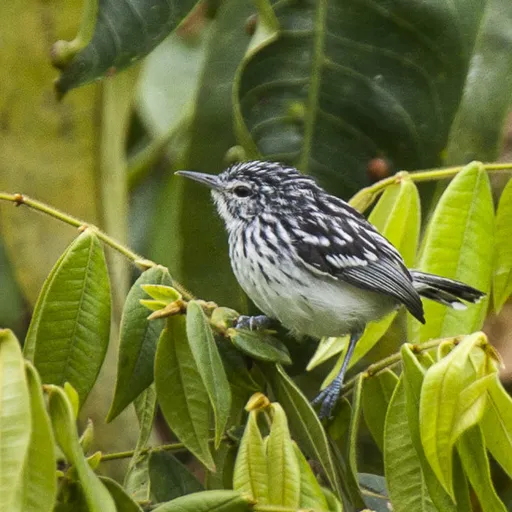
Stripe-chested Antwren
Myrmotherula longicauda
Least Concern
Listen
XC249455 · Niels Krabbe · Napo: 1 km S Puerto Napo, Ecuador · CC BY-SA 4.0
Overview
The stripe-chested antwren (Myrmotherula longicauda) is a small bird in the family Thamnophilidae. It is classified as Least Concern by the IUCN, despite a believed decreasing population trend, and is found across parts of South America.
Identification
- A smallish bird, 9 to 11 cm long, with a longer tail than other members of its genus.
- Adult males have a black and white streaked face and neck, with a black crown, back, and rump streaked with white or pale gray.
- The throat, breast, and belly are white, featuring light black streaks on the breast and flanks.
- The song is described as a fast repetition of a musical phrase, 'chidu-chidu-chidu-chidu...', up to 12 notes, or a slow, even-paced series of couplets: 'tee-tip tee-tip'.
Habitat
Found in a disjunct distribution along the eastern slope of the Andes in Bolivia, Colombia, Ecuador, and Peru, typically between 400 and 1,550 m in elevation. It inhabits the edges of humid evergreen forest, secondary forest, and bamboo stands. A disjunct population in Peru's Loreto Department lives in permanently flooded forest around blackwater lakes at about 150 m.
Diet
The diet, not yet studied in detail, includes insects and spiders. It forages singly or in pairs within dense foliage in the forest's mid-levels, 2 to 8 m above the ground. It actively seeks prey by reaching, lunging, and making brief sallies from a perch among leaves and vine tangles.
Did you know?
Although little is known about its breeding biology, its song is described in varied ways, from a fast, musical repetition to a descending 'tew' followed by quiet 'sick-sick' notes and a ringing, harsh rattle.
Sources
- Wikipedia · CC BY-SA 4.0
- Wikidata · CC0 1.0