
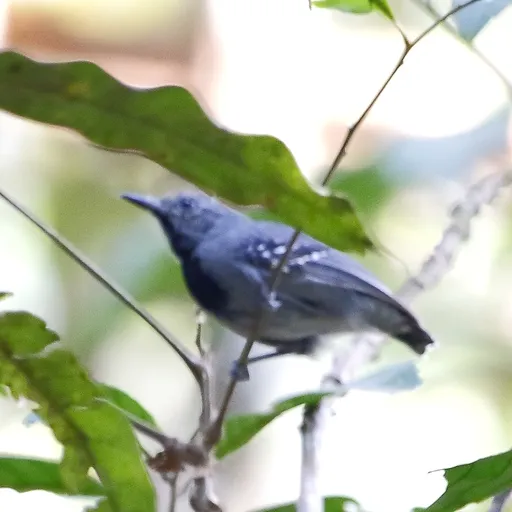
Long-winged Antwren
Myrmotherula longipennis
Least Concern
Listen
XC249581 · Niels Krabbe · Pastaza: Churunalpi, 5 km N Canelos, Ecuador · CC BY-SA 4.0
Overview
The long-winged antwren (Myrmotherula longipennis) is a species of bird in the family Thamnophilidae, known as the typical antbirds. It is considered a fairly common and stable species throughout its extensive range in South America, with no immediate threats identified.
Identification
- Size: A smallish bird, 9 to 10.5 cm in length, with a short tail.
- Male Plumage: Nominate males have dark gray upperparts, black throat and upper breast, and white tips on scapulars and tail feathers.
- Female Plumage: Characterised by an ochraceous face, olive-brown upperparts, and light buff throat and breast, with underparts that are mostly white with a gray tinge.
- Song: Nominate subspecies sing a series of harsh, upslurred, nasal 'suee' notes that gain in intensity but remain nearly constant in pitch and pace.
Habitat
Found in Bolivia, Brazil, Colombia, Ecuador, French Guiana, Guyana, Peru, Suriname, and Venezuela, this bird inhabits the understorey to mid-storey of evergreen and mature secondary forest. It occurs in lowlands and foothills at elevations ranging from below 500 m up to 1,100 m on Venezuelan tepuis, primarily in terra firme forest but also in várzea and igapó types.
Diet
Its diet consists mostly of insects and spiders, foraged singly, in pairs, or as part of mixed-species feeding flocks. Foraging typically occurs along thin, fairly open branches of understorey trees between 2 and 8 m above the ground, employing methods such as gleaning from live or dead foliage, reaching, lunging, and making short sallies.
Did you know?
Nests are constructed as a deep cup of fungal fibres covered with dead leaves and hung from a branch at heights up to approximately 12 m, though clutch size and incubation periods remain unknown.
Sources
- Wikipedia · CC BY-SA 4.0
- Wikidata · CC0 1.0