
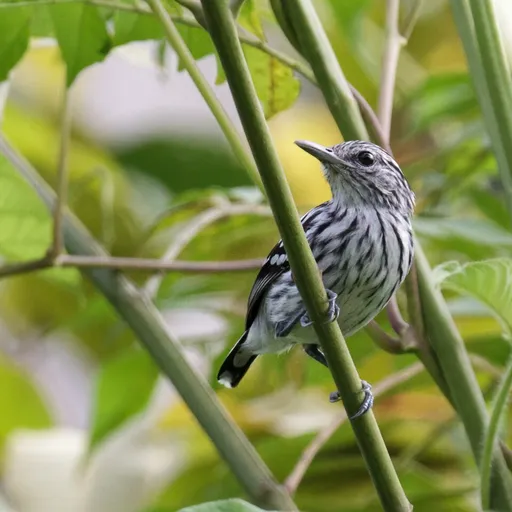
Pacific Antwren
Myrmotherula pacifica
Least Concern
Listen
XC248279 · Niels Krabbe · Esmeraldas: 7 km WNW Lita, Ecuador · CC BY-SA 4.0
Overview
The Pacific antwren, also known as the Pacific streaked antwren, is a small bird in the family Thamnophilidae. It is a year-round resident found in the lowland and foothill forests of Central and South America.
Identification
- A smallish bird measuring 9 to 10 cm in length with a tiny tail.
- Adult males feature a black and white streaked face, crown, and back, with a narrow white patch between the shoulders and black streaks on a white underside.
- Adult females have a buff to cinnamon-rufous head with black streaks on the crown and nape, and orange-ochre underparts without streaks.
- The song is described as a fast, spritely chipper that rises slightly in pitch, resembling 'chee-chee-chi-chich-ch-ch-ch-ch-ch-ch', accompanied by calls such as 'chee-pu' or a strident 'chrreee-chrreee-chrreee-chrreee!'.
Habitat
Found on both the Caribbean and Pacific slopes of Panama, and in central and western Colombia and Ecuador. It inhabits the understorey and mid-storey of lowland and foothill evergreen forest, as well as shrubby secondary forest, gardens, and plantations. Its range typically extends from sea level to about 800 m, though it can reach 1,200 m in parts of Colombia.
Diet
This species feeds on arthropods, particularly insects and spiders. It forages singly or in pairs, actively seeking prey among leaves, vine tangles, and along branches by reaching, lunging, and making brief sallies from a perch. Feeding occurs mostly in dense foliage between 2 and 10 m above the ground, though it can reach heights of 17 m.
Did you know?
The Pacific antwren is considered fairly common and less sensitive to human disturbance than most antbirds because it occupies a variety of shrubby forest-edge and second-growth habitats.
Sources
- Wikipedia · CC BY-SA 4.0
- Wikidata · CC0 1.0