
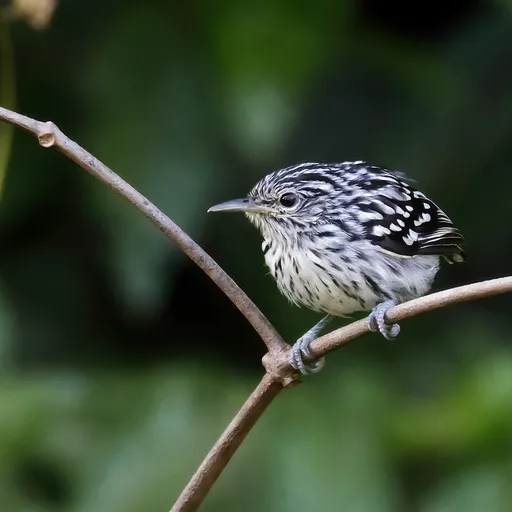
Guianan Streaked Antwren
Myrmotherula surinamensis
Least Concern
Overview
The Guianan streaked antwren (Myrmotherula surinamensis) is a species of bird in the family Thamnophilidae, commonly known as the typical antbirds. It is a small, active forest dweller that was historically classified as a 'nuthatch' before being moved to the genus Myrmotherula. The species is currently listed as Least Concern by the IUCN, though it faces local threats from deforestation.
Identification
- Measures 9 to 10.5 cm in length and weighs between 7.5 and 9 g, featuring a tiny tail.
- Males display a black and white streaked face, black crown and back with white streaks, and a large white patch between the shoulders; females have an orange-buff face with a cinnamon-rufous crown and black streaks.
- The song consists of a short, sharp, level trill described as 'd-rrrrr', accompanied by a slightly downslurred, complaining note or a short rattle.
- Wings are black with white tips on the coverts, and the tail is black with white edges and tips.
Habitat
Found from extreme eastern Colombia east through southern Venezuela, the Guianas, and northern Brazil, occurring only north and east of the Rio Negro and the Amazon River. It inhabits the understorey and mid-storey of lowland evergreen forest, particularly várzea and igapó, as well as shrubby secondary forest. The species occurs almost entirely near water, in thickets and vine tangles by rivers, streams, and ponds, at elevations ranging from sea level to 450 m.
Diet
The bird feeds on arthropods, especially insects and probably also spiders. It typically forages singly or in pairs between 1 and 15 m above the ground, actively seeking prey among leaves and vine tangles by reaching, lunging, and making brief sallies from a perch. It seldom joins mixed-species feeding flocks.
Did you know?
Although formally described as a 'nuthatch' by Johann Friedrich Gmelin in 1788, it is now recognised as an antwren. Its breeding season is not clearly defined, but nests have been found containing two eggs and one was observed in French Guiana covered in moss on a branch just 1 m above the water.
Sources
- Wikipedia · CC BY-SA 4.0
- Wikidata · CC0 1.0