
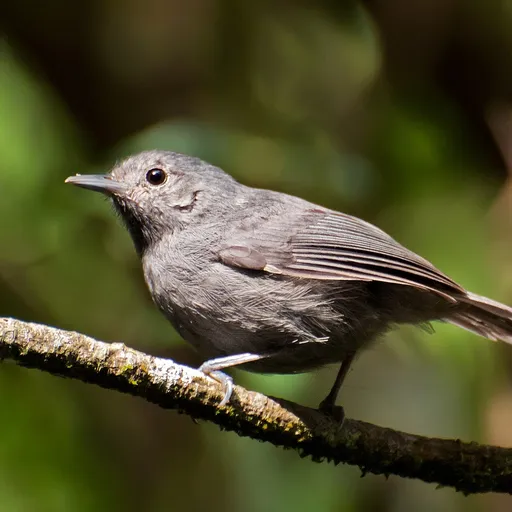
Unicolored Antwren
Myrmotherula unicolor
Least Concern
Overview
The unicolored antwren (Myrmotherula unicolor) is a small bird in the typical antbird family found exclusively in the Atlantic Forest of southeastern Brazil. It is classified as a species of Least Concern by the IUCN, although its population is believed to be decreasing due to habitat loss.
Identification
- Length 9–10 cm with a weight of 6.5–8 g, featuring a short tail.
- Males are almost entirely grey with lighter underparts, while females have olive-brown upperparts with a greyish crown and yellowish-brown uppertail coverts.
- Song is described as an irregular series of very high, sharp, drawn-out, well-separated 'Seeep' notes.
- Calls include a sharp 'wheet', paired nasal notes, and longer, flat, raspy notes.
Habitat
Endemic to the Atlantic Forest along the coast of southeastern Brazil, ranging from northern Rio de Janeiro state to northern Rio Grande do Sul. It inhabits the understorey to mid-storey of evergreen and mature secondary forests, occasionally found in restinga woodlands on white-sand soils. The species favours dense viny understorey in stunted forest with a canopy up to 20 m high, occurring at elevations from sea level to 500 m.
Diet
The diet is probably composed mostly of insects and spiders, though details are not fully known. Foraging occurs singly, in pairs, in family groups, or within mixed-species feeding flocks, mostly between 0.5 m and 5 m above the ground. Prey is actively sought among vine tangles and leaves by reaching, stabbing, hanging, hover-gleaning, and short sallies from perches.
Did you know?
The nest is a cup constructed from roots, dead leaves, and fungal fibers, hung from a branch fork typically within about 2 m of the ground. Active nests have been noted in November, although the specific breeding season remains unknown.
Sources
- Wikipedia · CC BY-SA 4.0
- Wikidata · CC0 1.0