
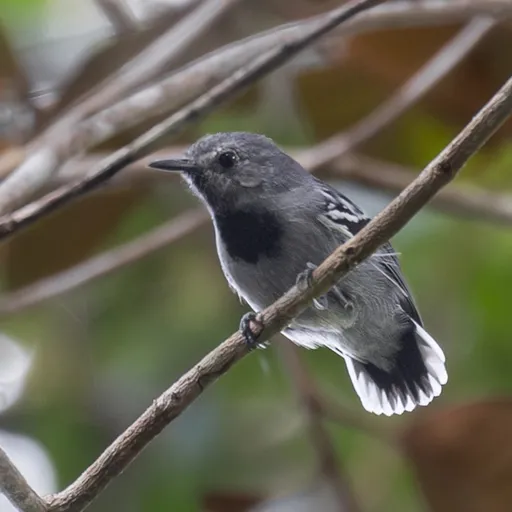
Band-tailed Antwren
Myrmotherula urosticta
Vulnerable
Overview
The band-tailed antwren (Myrmotherula urosticta) is a small, insectivorous bird belonging to the family Thamnophilidae. Classified as a Vulnerable species by the IUCN, it is endemic to Brazil and exists as a single taxonomic subspecies.
Identification
- Length of 9 to 10 cm with a short tail.
- Males have grey upperparts, a hidden white patch between the shoulders, and a dark grey tail featuring a wide white band.
- Males possess black throats and upper breasts, while females have white throats, grey faces, and pale cinnamon-buff underparts.
- Song consists of a short series of 4-5 high, nasal, sharply upslurred 'tjeuwi' notes, with common calls of three notes dropping in pitch.
Habitat
This species inhabits the understorey to mid-storey of evergreen forest and adjacent mature secondary forest in the lowlands of the Atlantic Forest. It is found in coastal eastern Brazil between Bahia and northern Rio de Janeiro, with the largest numbers in the southern Bahia-northern Espírito Santo area. The bird favours tall forest on sandy soil with abundant vines and occurs at elevations below approximately 500 m.
Diet
The diet is believed to consist mostly of insects and spiders. The bird forages singly, in pairs, in family groups, or as part of mixed-species flocks, primarily on open leafy branches. It gathers prey by gleaning live leaves, reaching into dead leaf clusters and vine tangles, and performing short sallies from perches at heights between 3 and 10 m, occasionally reaching up to 20 m.
Did you know?
Although the species is known from five protected areas in southern Bahia, significant portions of these reserves contain habitat unsuitable for the bird, meaning the effective protected area is much smaller than it appears.
Sources
- Wikipedia · CC BY-SA 4.0
- Wikidata · CC0 1.0