
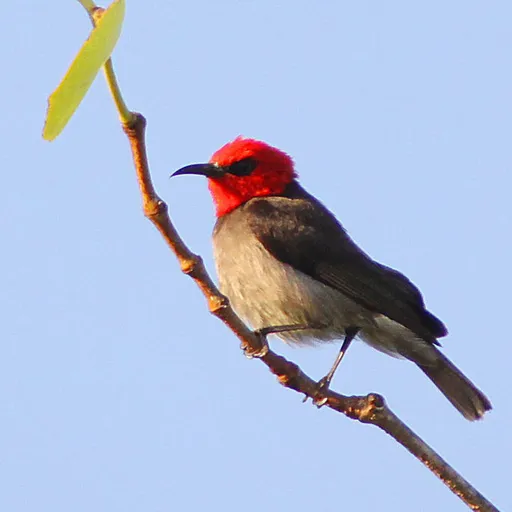
Red-headed Myzomela
Myzomela erythrocephala
Least Concern
Overview
The red-headed myzomela (Myzomela erythrocephala), also known as the red-headed honeyeater, is a small passerine bird of the honeyeater family found in mangrove forests across Australia, Indonesia, and Papua New Guinea. Though widely distributed, the species is not abundant within its range.
Identification
- Size: A small bird at 12 cm in length with a compact body, short tail, and a relatively long, down-curved bill.
- Plumage: Sexually dimorphic; males have a glossy red head, neck, and rump sharply demarcated from blackish-brown upperparts and grey-brown underparts, while females are predominantly grey-brown with a pink-red tint on the forehead and chin.
- Song: Calls are metallic or scratchy, including an abrupt 'tchwip-tchwip-tchwip-tchwip' song, a softer 'swip-swip' contact call, and a scolding 'charrk-charrk'.
Habitat
Primarily a mangrove specialist, it inhabits monsoonal coastal areas, especially thickets of spotted mangrove, smallflower bruguiera, and grey mangrove, often near paperbark fringes. Its range covers the tropical coastlines of Western Australia, the Northern Territory, Queensland, and scattered sites in West Papua and southern New Guinea.
Diet
It forages actively in the tree canopy, darting from flower to flower to probe for nectar with its curved bill and gleaning insects from foliage and twigs. In north-western Australia, it is the major pollinator of the rib-fruited mangrove and may travel significant distances to reach flowering plants.
Did you know?
Males are highly antagonistic even towards their own species, engaging in aggressive grappling fights in mid-air that often result in both birds falling close to the ground before disengaging.
Sources
- Wikipedia · CC BY-SA 4.0
- Wikidata · CC0 1.0