
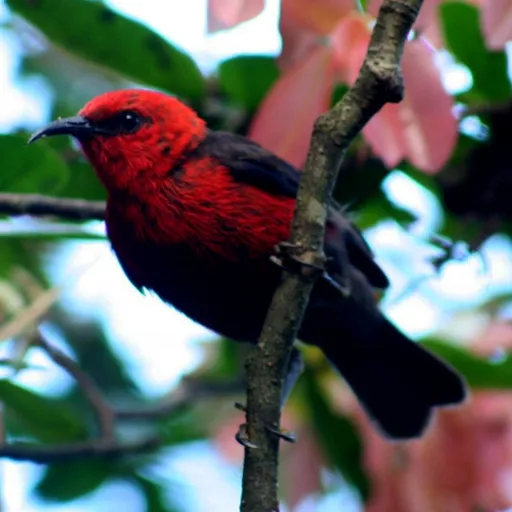
Micronesian Myzomela
Myzomela rubratra
Least Concern
Overview
The Micronesian myzomela (Myzomela rubratra) is a small honeyeater native to the Caroline and Mariana archipelagos in Micronesia. It is currently classified as a least-concern species by the IUCN, with a total estimated population of between 850,000 and 900,000 individuals.
Identification
- Measures 13 cm in length, with a distinctly down-curved bill that is yellow-based in juveniles and black in adults.
- Males feature a predominantly black body with vermilion scarlet-red patches, while females have a brown body with scarlet-red patches and dusky tail and wing feathers fringed with olive.
- Emits a complex dawn song described as a continuous stream of trilled whistles, resembling multiple birds singing in unison, and produces a simple daytime song transcribed as "per-mit-you" on the Mariana Islands.
Habitat
Found throughout the Caroline and Mariana Islands, this species inhabits forest edges, coconut plantations, coastal strands, savanna brush, and human-modified areas such as villages, towns, and gardens. It is particularly common in mangroves and agroforestry systems, and on some islands, such as Palau, it is rare in unbroken mature native forest.
Diet
An omnivore that feeds on nectar and small invertebrates, mainly insects. It forages primarily by flying or hopping, as it is a weak flyer that typically travels only short distances, rarely more than five metres, through the air.
Did you know?
The species' specific epithet, rubratra, is a Latin compound of rubra and atra, meaning 'red' and 'black', accurately describing its striking plumage. The Micronesian myzomela was driven to local extinction on Guam in 1986 by the introduced brown tree snake.
Sources
- Wikipedia · CC BY-SA 4.0
- Wikidata · CC0 1.0