
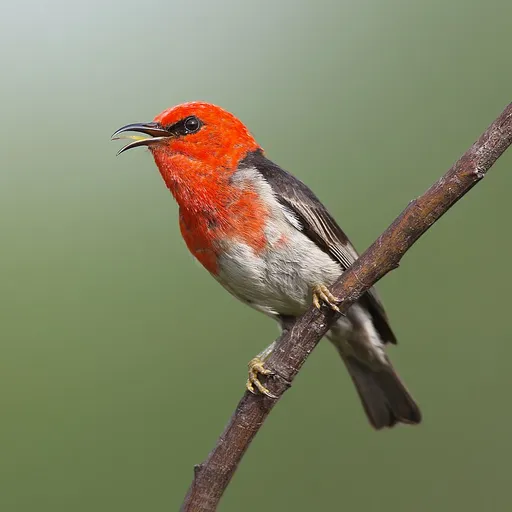
Scarlet Myzomela
Myzomela sanguinolenta
Least Concern
Overview
The scarlet myzomela, also known as the scarlet honeyeater, is a small passerine bird native to Australia and the smallest honeyeater on the continent. First described in 1801, it is a distinctive species within the family Meliphagidae, characterised by its bright colouring and vocal nature.
Identification
- The adult male is a striking bright red with a narrow black stripe from beak to eye, a thin black eye-ring, and black wings, while the female is entirely brown with occasional pinkish patches on the face.
- It is a compact bird, 9 to 11 cm long, with a short tail and a relatively long, down-curved black bill.
- The species is more vocal than most honeyeaters, producing a tuneful, bell-like tinkling call often likened to cork being rubbed on glass.
Habitat
The scarlet myzomela inhabits dry sclerophyll forest and woodland, generally with eucalypts as dominant trees and little understorey. Its range extends along most of Australia's eastern coastline from far north Queensland to Gippsland in Victoria, with some inland extensions, and it is migratory in the southern parts of its range.
Diet
This omnivorous bird forages mainly in the upper tree canopy, darting from flower to flower to probe for nectar with its long curved bill. It also sallys for flying insects such as beetles, flies, bugs, and caterpillars.
Did you know?
At just 9 to 11 cm in length, it is the smallest honeyeater in Australia.
Sources
- Wikipedia · CC BY-SA 4.0
- Wikidata · CC0 1.0