
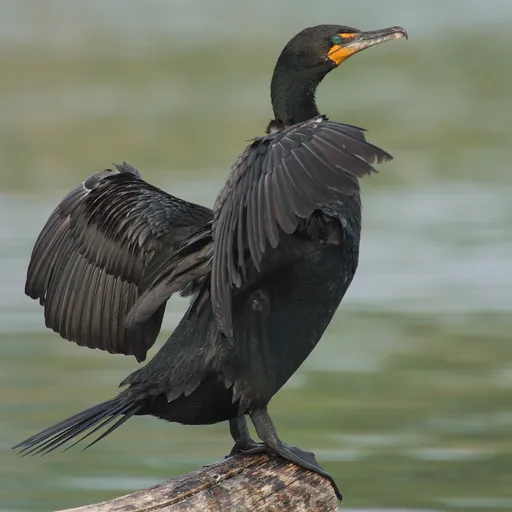
Double-crested Cormorant
Nannopterum auritum
Listen
XC177731 · Jonathon Jongsma · Powderhorn Park, Minneapolis, Hennepin, Minnesota, United States · CC BY-SA 4.0
Overview
The double-crested cormorant (Nannopterum auritum) is a large water bird within the cormorant family, widely distributed across North America. It is a stocky bird with a long neck and hooked bill, found in both coastal and inland freshwater environments.
Identification
- Body length ranges from 70–90 cm with a wingspan of 114–123 cm; adults are mostly black with a bare patch of orange-yellow skin on the face.
- Breeding adults display a double crest of feathers that are white, black, or mixed, located just above the eyes.
- Juveniles have dark grey or brownish plumage with a lighter underbelly and a mostly orange or yellowish bill.
- It is distinguished from the similar great cormorant by having more yellow on the throat and bill, and it produces a deep, guttural grunt call.
Habitat
Found near rivers, lakes, and coastal areas, this species is widely distributed from the Aleutian Islands in Alaska down to Florida and Mexico. It winters in ice-free areas on both coasts and can be found as far south as the Bahamas, though it has occasionally occurred as a rare vagrant in Europe.
Diet
Primarily a fish eater, it forages by swimming low in the water and diving to depths of 1.5–7.5 m for up to 70 seconds. It may also consume amphibians, crustaceans, and insects, with larger fish often being brought to the surface before being eaten.
Did you know?
Like all cormorants, its feathers are not fully waterproof, meaning it must spend long periods standing with its wings outstretched to dry them after diving. Additionally, biologists can dissect regurgitated pellets containing undigested bones to determine the bird's specific diet.