
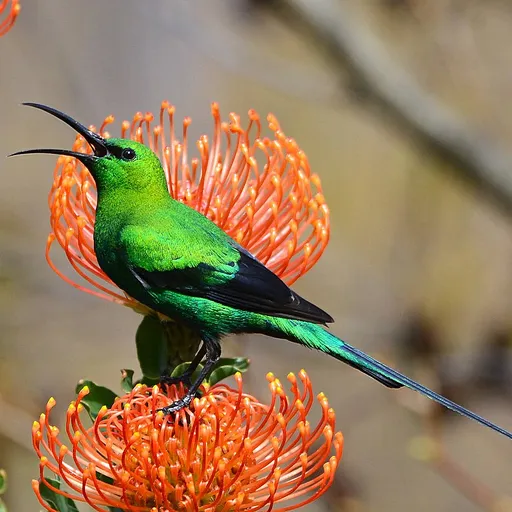
Malachite Sunbird
Nectarinia famosa
Least Concern
Overview
The malachite sunbird (Nectarinia famosa), also known as the green sugarbird, is a small nectarivorous passerine found from the highlands of Ethiopia southwards to South Africa. As a fairly large sunbird, it plays a vital role in pollinating many flowering plants, particularly those with long corolla tubes in the Fynbos.
Identification
- Breeding male: Metallic green plumage with blackish-green wings and small yellow pectoral patches, featuring very long central tail feathers that reach a length of 25 cm.
- Female and Juvenile: Brown upperparts, dull yellow underparts with indistinct breast streaking, and a square-ended tail measuring approximately 15 cm.
- Bill and Legs: Possesses long, thin, down-curved bills and brush-tipped tubular tongues adapted for nectar feeding.
- Song and Call: Emits a loud tseep-tseep call, while males produce a twittering song accompanied by upward head movements and displays of yellow pectoral tufts.
Habitat
This species inhabits hilly Fynbos, including Protea and aloe stands, as well as cool montane and coastal scrub up to 2,800 m altitude in South Africa. It also occurs in parks and gardens, often nesting in those located in the Highveld. The bird is resident but may move downhill during winter.
Diet
Primarily feeding on nectar, this sunbird often perches to feed rather than hovering. It also consumes insects, particularly when feeding young, and may hawk for prey from a perch similar to a flycatcher.
Did you know?
Male malachite sunbirds display their pectoral tufts almost continuously throughout the night, even while asleep, a behaviour hypothesised to function as eyespots that deter nocturnal predators.
Sources
- Wikipedia · CC BY-SA 4.0
- Wikidata · CC0 1.0