
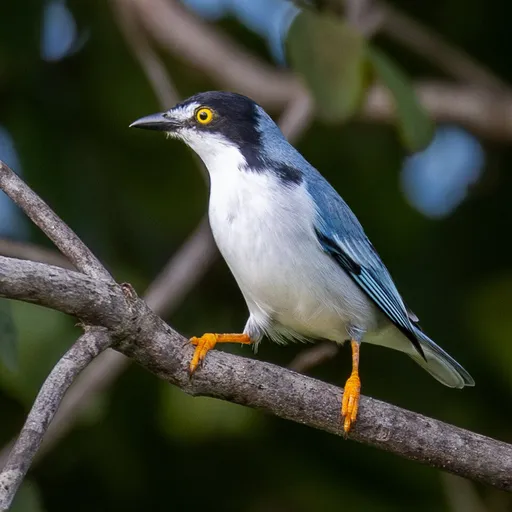
Hooded Tanager
Nemosia pileata
Least Concern
Overview
The hooded tanager (Nemosia pileata) is a species of bird in the family Thraupidae. It is a year-round resident found in every mainland South American country except Chile, Ecuador, and Uruguay.
Identification
- Adult males have a black head with white lores and a white throat, contrasting with grayish-blue upperparts and white underparts.
- Adult females share the white lores but have a uniformly grayish-blue head, with white underparts that show a buff tinge on the throat and breast.
- The species is small, measuring 12 to 13.5 cm in length, and features yellow irises with yellow or yellow-brown legs.
- The dawn song is described as a "short, very high, thin, rapidly descending" sequence of notes such as ti-ti-ti-si-sui-sui-seeh.
Habitat
The species inhabits a variety of wooded landscapes, including gallery, secondary, and mangrove forests, as well as riverine forests and plantations. It is found at elevations below 500 m in Colombia and below 600 m in Venezuela and Brazil. Its distribution is disjunct, with a significant gap in the northern Amazon Basin between northern and southern populations.
Diet
The hooded tanager feeds primarily on insects, occasionally consuming fruit and possibly nectar. It forages in pairs or family groups and occasionally joins mixed-species flocks, typically operating high in the trees. Prey is mainly gleaned from leaves and bark, though the bird may take insects from spider webs using a brief hover.
Did you know?
The nest is an open cup constructed from plant fibers and is attached to a high branch using spider web. Both sexes participate in building the nest, although the female is solely responsible for incubation.
Sources
- Wikipedia · CC BY-SA 4.0
- Wikidata · CC0 1.0