
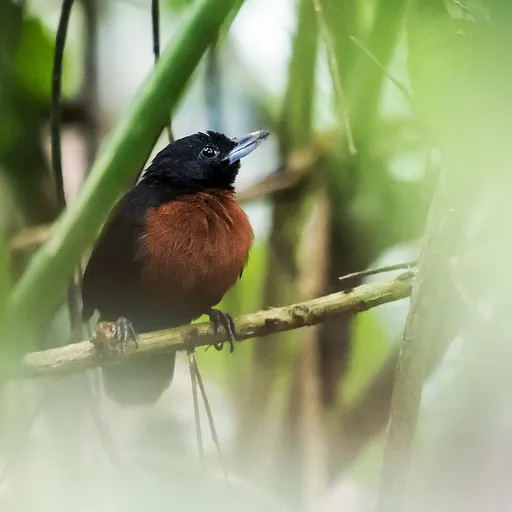
Black Bushbird
Neoctantes niger
Least Concern
Listen
XC249465 · Niels Krabbe · Napo: 1 km S Puerto Napo, Ecuador · CC BY-SA 4.0
Overview
The black bushbird (Neoctantes niger) is a species of bird in the family Thamnophilidae, known as the typical antbirds. It is the sole member of the genus Neoctantes and is found across parts of South America, though it remains a relatively rare and secretive species.
Identification
- Length of 15 to 16 cm with a stocky build, short tail, and an unusual upturned bill.
- Adult males are entirely black with a small, mostly hidden patch of white between the shoulders.
- Adult females are mostly sooty black with a rufous breast and upper belly.
- Song consists of a slightly rising series of semimusical 'werk' notes; calls are a distinctive, squealing, two-parted nasal 'kyoo'.
Habitat
The species inhabits lowland terra firme and várzea evergreen forests, favouring dense undergrowth along forest edges, treefalls, and swampy streams. Its range spans south-central and southeastern Colombia, eastern Ecuador, northeastern and southeastern Peru, and western Brazil, with isolated populations in central Amazonian Brazil.
Diet
It feeds primarily on insects and other arthropods, foraging singly or in pairs within dense vegetation from the ground up to 10 m in height. It uses its upturned bill to pick, hammer, and dig into branches, woody vines, and rotten wood to wedge or flake off bark and substrate.
Did you know?
Only a single nest has ever been documented for this species, which was found suspended in a shrub's branch fork in Peru, where the male was observed incubating a single egg.
Sources
- Wikipedia · CC BY-SA 4.0
- Wikidata · CC0 1.0