
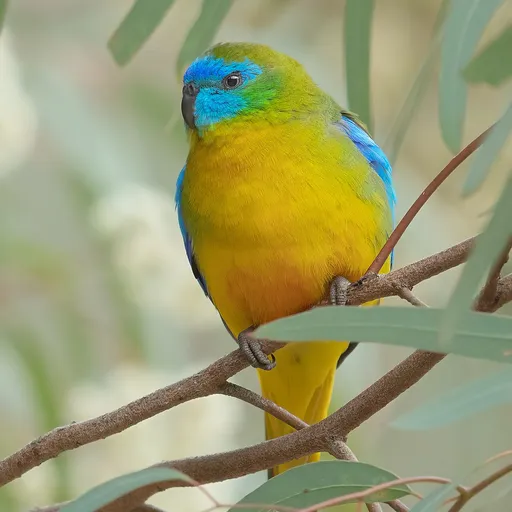
Turquoise Parrot
Neophema pulchella
Least Concern
Overview
The turquoise parrot (Neophema pulchella) is a small, lightly built species of parrot native to eastern Australia, occurring in south-eastern Queensland, New South Wales and north-eastern Victoria. It is a predominantly ground-based seed eater that inhabits open woodlands and grasslands, exhibiting marked sexual dimorphism where males are brightly coloured and females are duller.
Identification
- Males possess a bright turquoise-blue face, grass-green upperparts, and wings that appear bright blue with a distinct band of red on the shoulder.
- Females are generally duller with a paler blue face, pale green chest, and yellow belly, lacking the red shoulder patch but displaying a broad white bar on the underwing when flying.
- Small and light, measuring 20–22 cm in length with a 32 cm wingspan and weighing approximately 40 g, with grey legs and feet and a black or grey-brown upper mandible.
- Calls include a high-pitched soft contact call during feeding or flight, a high-pitched zitting alarm call, and chattering when settling to roost.
Habitat
Found in the foothills of the Great Dividing Range and surrounding areas, the species inhabits open woodland and savanna composed of native cypress or eucalypts, particularly white box, yellow box, and red box. It prefers rocky ridges, gullies, or transitional areas between woodland and grassland, though it is considered sedentary and does not migrate, though some populations may be locally nomadic to follow water availability.
Diet
Predominantly a ground-based seed eater, the turquoise parrot forages in clearings, forest margins, and pastures, often in pairs or small troops, preferring shaded areas for camouflage. Its diet consists mainly of grass and shrub seeds, with occasional consumption of leaves, flowers, fruit, and scale insects, including specific plants like guinea-flower, daphne heath, and introduced quaking grasses.
Did you know?
During courtship, the male perches upright on a tree stump and extends its wings to display its red and blue markings to the female. A female was once observed placing leaves of flaky-barked tea-tree under its feathers, leading observers to speculate that they were used to deter or kill insects.
Sources
- Wikipedia · CC BY-SA 4.0
- Wikidata · CC0 1.0