
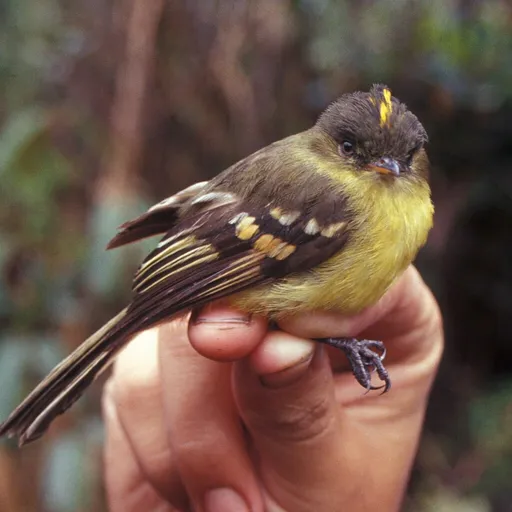
Orange-banded Flycatcher
Nephelomyias lintoni
Least Concern
Listen
XC251244 · Niels Krabbe · Zamora-Chinchipe: camp on Ventanilla-Christopher Parson trail, Reserva Tapichalaca, Ecuador · CC BY-SA 4.0
Overview
The orange-banded flycatcher (Nephelomyias lintoni) is a small tyrant flycatcher found in the Andes of South America. It inhabits humid montane and elfin forests in southern Ecuador and far northern Peru, where it is considered local to uncommon.
Identification
- Small bird measuring 12.5 to 13 cm in length with a dark brownish olive back and rump.
- Wings are dusky with two distinct wing bars formed by cinnamon, ochraceous, or buffy tips on the coverts.
- Adults feature a yellow or rufous patch in the middle of a very dark crown, partially hidden, and a thin pale yellow eye-ring.
- Bill has a blackish maxilla and an orange mandible with a black tip; legs and feet are blackish.
Habitat
This species is found on the eastern slope of the Andes, ranging from Azuay and Morona-Santiago provinces in southern Ecuador down to the Piura and Amazonas departments in far northern Peru. It inhabits humid montane and elfin forest, as well as early successional growth in disturbed areas such as landslides, typically at elevations between 2,250 and 3,200 m.
Diet
The orange-banded flycatcher feeds mostly on insects and some small seeds. It forages in small groups from the mid-story to the canopy, often joining mixed-species feeding flocks, and takes prey from foliage using short flights to hover-glean or by capturing it in mid-air.
Did you know?
The bird's dawn song is described as a simple and monotonous series of 'tsin' notes, contrasting with its sharp and arresting 'peeyk' call, which is given repeatedly while foraging.
Sources
- Wikipedia · CC BY-SA 4.0
- Wikidata · CC0 1.0