
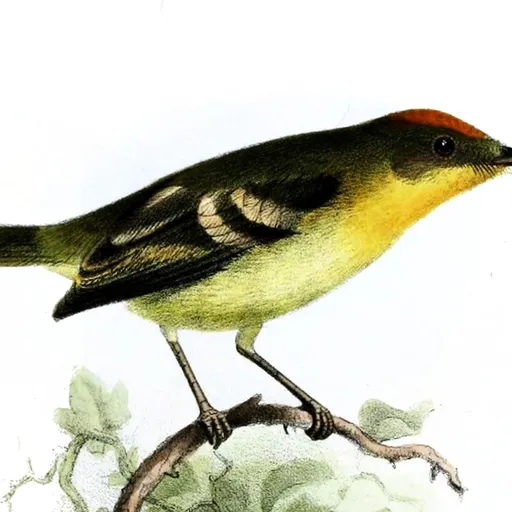
Handsome Flycatcher
Nephelomyias pulcher
Least Concern
Listen
XC251245 · Niels Krabbe · Napo: 'Cabañas San Isidro', 1-2 km SW Cosanga, Ecuador · CC BY-SA 4.0
Overview
The Handsome Flycatcher, scientifically known as Nephelomyias pulcher, is a species of bird in the tyrant flycatcher family found across the Andes. It is currently classified as Least Concern on the IUCN Red List, though its population is believed to be decreasing.
Identification
- Size and Structure: A small bird measuring 9.5 to 11 cm in length with a rather short, dusky tail and a small bill featuring a black maxilla and an orange-yellow mandible.
- Plumage: Features an olive-gray face with a white spot above the lores and a broken white eye-ring; wings are dusky with two distinct pale ochre wing bars; throat and breast are dull ochre-yellow with a paler yellow belly.
- Markings: Adult males of the nominate subspecies display a partly hidden orange-rufous patch in the middle of the crown, which may be duller or absent in females; subspecies vary in upperpart coloration and breast banding.
- Vocalisation: The song is described as a rather sharp and clear 'tsi-tsi-tsi', accompanied by calls such as a high, thin 'tsew-tsip' or a descending sputtering trill.
Habitat
This species inhabits the interior and edges of humid subtropical forests, including both primary and secondary growth, at elevations ranging from 1,500 to 2,600 m. It has a disjunct distribution across the western and eastern slopes of the Andes in Colombia, Ecuador, and Peru, with hypothetical presence in Bolivia.
Diet
The Handsome Flycatcher feeds on insects, typically foraging in small groups, possibly families, within the mid-story to canopy of the forest. It often joins mixed-species feeding flocks and takes prey from foliage using short flights to hover-glean, as well as capturing insects in mid-air.
Did you know?
Although the species has a large range, its exact population size remains unknown, and it is assessed as having a decreasing trend despite no immediate threats being identified.
Sources
- Wikipedia · CC BY-SA 4.0
- Wikidata · CC0 1.0