
Pink Pigeon
Nesoenas mayeri
Vulnerable
Overview
The pink pigeon (Nesoenas mayeri) is a Vulnerable species of pigeon in the family Columbidae endemic to Mauritius and the tiny predator-free island of Île aux Aigrettes. As the only surviving Mascarene pigeon, the species nearly became extinct in the 1970s and 1990s, recovering from a low of 10 individuals in 1991 to approximately 400 in the wild by 2018 due to conservation efforts.
Identification
- Measures 36–38 cm from beak to tail and weighs approximately 350 g.
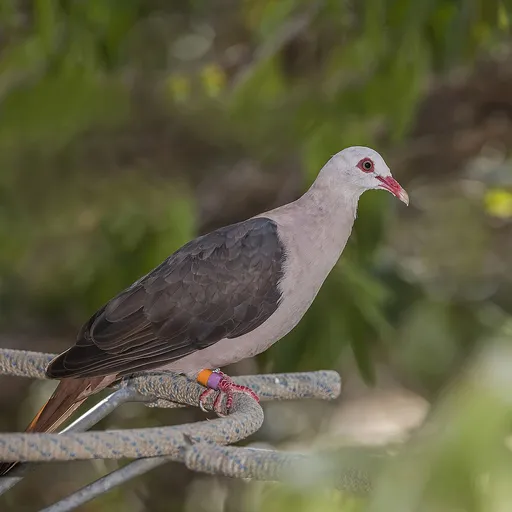
- Features pale pinkish-grey plumage on the head, shoulders and underside, with dark brown wings and a broad, rust-coloured tail.
- Has a dark pink bill with a white tip, pink feet, and dark brown eyes surrounded by a red skin eye-ring.
- Flight call is a short, hardened 'hoo hoo', while the male's territorial call consists of a series of coos.
Habitat
The species is endemic to the Mascarene island of Mauritius and the nearby island of Île aux Aigrettes in the Indian Ocean. It prefers upland evergreen forests but can also inhabit coastal forests provided the vegetation is native and not dominated by introduced species such as Chinese guava or privet. Wild populations are currently located within Black River Gorges National Park and Isle aux Aigrettes, with the species being non-migratory.
Diet
Pink pigeons are herbivorous, consuming buds, flowers, leaves, shoots, fruits and seeds from both native and exotic plants. They exhibit ground-feeding behaviours, moving and turning over leaf litter to locate food and grit for use as gizzard stones. Due to habitat degradation, they often rely on supplemental feeding stations providing items such as whole wheat.
Did you know?
Males have a significantly longer life expectancy than females, living roughly five years more in the wild, as the continuous production of eggs is metabolically taxing for females. Males can remain fertile until 17–18 years in captivity, whereas females reach only 10–11 years.
Sources
- Wikipedia · CC BY-SA 4.0
- Wikidata · CC0 1.0