
Yellow-throated Honeyeater
Nesoptilotis flavicollis
Least Concern
Overview
The yellow-throated honeyeater (Nesoptilotis flavicollis) is a passerine bird endemic to Tasmania, King Island, and the Furneaux Group in Australia. It is a medium-sized species similar in appearance and behaviour to the white-eared honeyeater, though it has been the subject of various taxonomic revisions.
Identification
- Medium-sized bird, averaging 21 cm in length with a relatively long tail.
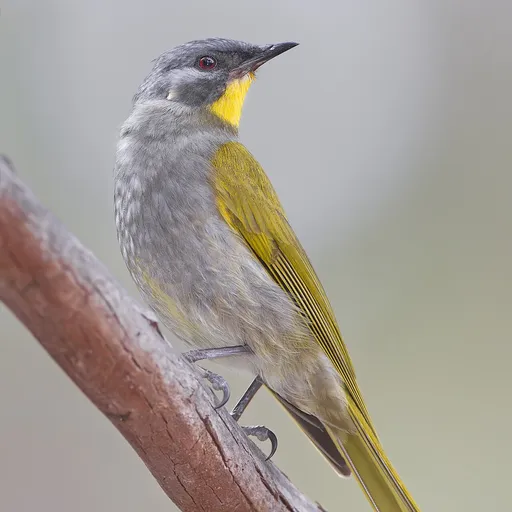
- Plumage is bright olive-green above, contrasting with a silver-grey crown, face, and underbelly, and a distinctive bright yellow chin and throat.
- Features a small yellow ear-patch, wing feathers outlined in yellow, a black bill, and deep ruby-red eyes.
- Breeding calls include a whirring 'chur-uk' or loud 'de-wit', while other common calls consist of repeated 'tonk' or 'tchook' sounds.
Habitat
Found in temperate forests, woodlands, coastal scrub, and heath, with a preference for wet and dry sclerophyll forests. The species is also present in modified environments such as golf courses, orchards, parks, and gardens.
Diet
Feeds primarily on arthropods, supplemented by nectar, occasional fruit, and seeds. Foraging occurs singly or in pairs from the canopy to the ground, involving gleaning from trunks and branches, probing loose bark, and making sallying flights.
Did you know?
The female constructs the nest from materials such as grass, bark shreds, and spider's web, and is known to collect hair from live animals, including horses, dogs, and humans, to line it.
Sources
- Wikipedia · CC BY-SA 4.0
- Wikidata · CC0 1.0