
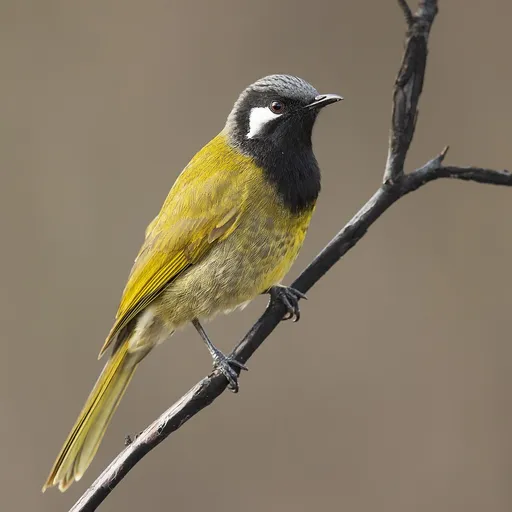
White-eared Honeyeater
Nesoptilotis leucotis
Least Concern
Overview
The white-eared honeyeater (Nesoptilotis leucotis) is a medium-sized honeyeater found in Australia, belonging to the family Meliphagidae. Classified as Least Concern on the IUCN Red List despite a decreasing population, it is a relatively unselective species that thrives in various forest and woodland environments.
Identification
- Olive-green upper and lower body with a dark grey crown marked by black streaks.
- Distinctive black cheeks and throat contrasted by prominent white ear-coverts.
- Medium-sized bird measuring 19–22 cm in length, with a black bill and dark grey legs.
- Vocalisations include a deep, mellow, slightly metallic 'chwok, chwok, chwok-whit' and a sharp, scratchy 'chwik!'.
Habitat
Found throughout eastern Australia from central Queensland to Victoria and South Australia, as well as in southwestern Western Australia and Kangaroo Island. This species prefers forests, woodlands, heathlands, mallee, and dry inland scrublands, specifically seeking areas with a eucalyptus canopy, rough bark, and a shrub layer. Populations in arid regions and the Mallee, including the western subspecies, can survive without a shrub layer or understory.
Diet
White-eared honeyeaters feed on both nectar and insects, switching from nectar in spring and summer to insects for the remainder of the year. They actively probe tree trunks and branches, particularly those with soft, peeling, or flaking bark, to collect termites, spiders, lerp, and honeydew. Their foraging is characterised by a high volume of activity, averaging one insect every five seconds, which suggests the insects consumed are of low nutritional value.
Did you know?
White-eared honeyeaters are obligate cooperative breeders that will pluck fur and hair from livestock, native wildlife such as kangaroos and wallabies, and even humans to line their nests.
Sources
- Wikipedia · CC BY-SA 4.0
- Wikidata · CC0 1.0