
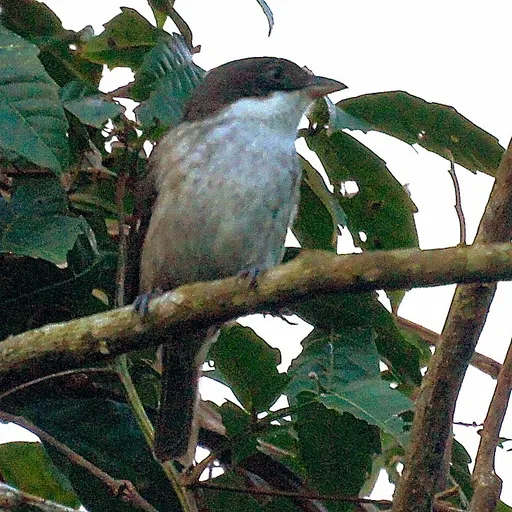
Puerto Rican Tanager
Nesospingus speculiferus
Vulnerable
Overview
The Puerto Rican tanager (Nesospingus speculiferus) is a small passerine bird endemic to the archipelago of Puerto Rico and currently listed as Vulnerable on the IUCN Red List. It is the sole member of the genus Nesospingus and is known locally as llorosa, meaning 'cryer'.
Identification
- Small passerine measuring 18–20 cm in length with olive-brown upperparts and pale grey to white underparts.
- Adults possess a conspicuous white wing spot, a dark crown and face that obscures the eye, and pure white throats.
- Males exhibit a brown-black maxilla with a white mandible, whereas females have entirely black bills.
- Vocalisations include a harsh 'chewp' or 'chuck' call, often extended into 'chi-chi-chit', and a breeding song described as light and rapidly sung 'tswet-tswet-tswet'.
Habitat
This species is restricted to mid- to high-elevation montane forests between 300 and 1,350 m, specifically mature and second-growth subtropical rain and wet forests on the island of Puerto Rico. Its population is concentrated on the eastern and western sides of the central cordillera, particularly in El Yunque National Forest and Maricao State Forest.
Diet
The Puerto Rican tanager feeds primarily on invertebrates such as spiders, insects, centipedes, and snails, along with fruits from genera such as Cecropia and Clusia. Eleutherodactylus tree frogs, including the common coquí, also form an important part of its diet, though it occasionally consumes lizards and other bird nestlings.
Did you know?
The common local name for this bird, llorosa, translates to 'cryer', likely a reference to its vocalisations. Despite being strong flyers, they rarely travel long distances, preferring to make short flights through the canopy or brush.
Sources
- Wikipedia · CC BY-SA 4.0
- Wikidata · CC0 1.0