
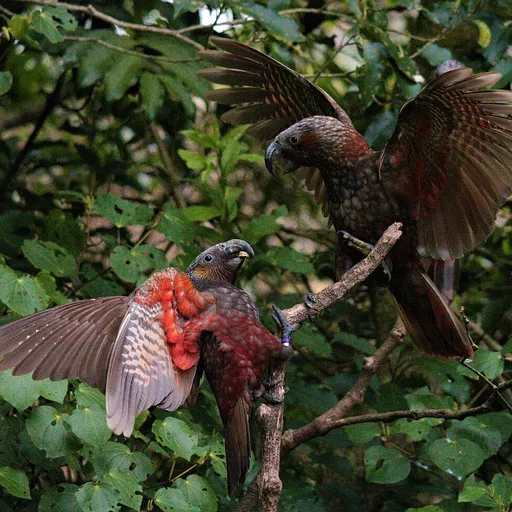
New Zealand Kaka
Nestor meridionalis
Vulnerable
Overview
The New Zealand kākā (Nestor meridionalis) is a medium-sized parrot belonging to the family Strigopidae, native to the forests of New Zealand. Classified as Vulnerable on the IUCN Red List, the species has seen a decline in its range but is recovering in certain areas, such as Zealandia in Wellington.
Identification
- Medium-sized parrot measuring 45 cm in length, with a body weight ranging from 390 to 560 g.
- Plumage is strongly patterned in brown, green, and grey, featuring a greyish-white forehead and crown with reddish tones on the neck and abdomen.
- Distinct orange and scarlet flashes are visible under the wings during flight.
- Vocalisations include a harsh 'ka-aa' and a whistling 'u-wiia'.
Habitat
The kākā inhabits lowland and mid-altitude native forests, preferring mature woodlands with complex canopies. Although once widespread, its current distribution is limited to strongholds such as Kapiti Island, Codfish Island / Whenua Hou, and Little Barrier Island, with reintroduction efforts expanding its presence on the mainland.
Diet
The kākā feeds on fruits, berries, seeds, flowers, nectar, sap, and invertebrates, often using its strong beak to shred kauri cones and dig out grubs. It possesses a specialised brush tongue that allows it to lap up nectar and sap from trees like kōwhai, rātā, and pōhutukawa, as well as honeydew.
Did you know?
Kākā demonstrate high intelligence by testing various points on a tree to find weak spots before removing bark to access sap. They also exhibit complex social play, such as play fighting and chasing, which aids in cognitive development and social bonding.
Sources
- Wikipedia · CC BY-SA 4.0
- Wikidata · CC0 1.0