
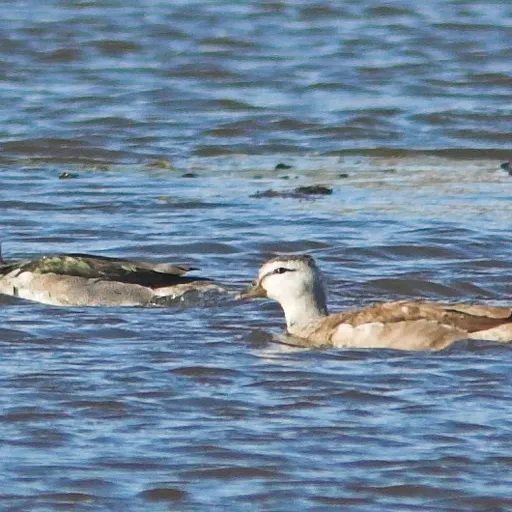
Cotton Pygmy Goose
Nettapus coromandelianus
Least Concern
Overview
The cotton pygmy goose (Nettapus coromandelianus) is a small perching duck found in South and Southeast Asia, extending to Queensland in Australia. Among the smallest waterfowl in the world, these birds are known for their strong flight capabilities and tendency to disperse widely, particularly in winter. They usually occur in pairs or larger groups, roosting and nesting on trees near water bodies.
Identification
- Males have a dark brown forehead and crown with a blackish-green broad collar, while females possess a duller cap and a brown line through the eye.
- The bill is short and deep at the base, appearing goose-like, with black legs that are greenish in breeding males.
- In flight, males display dark wings with white flight feathers tipped in black, whereas females show a white trailing edge to the secondaries.
- They produce a low quacky call described as sounding like 'quacky duck' or 'fixed bayonets'.
Habitat
This species inhabits tropical and subtropical regions across Asia, extending to Australia, and favours lakes, ponds, and shallow water bodies with ample emergent or floating vegetation. They are often found in habitats dominated by flora such as water lilies and aquatic sedges, and occasionally utilise irrigation ponds or flooded paddies. In Australia, they are mainly found in lagoons, and they typically roost on trees near their preferred foraging areas.
Diet
Cotton pygmy geese feed mainly at the surface of the water, consuming small fishes, molluscs, crustaceans, insect larvae, and plant matter. They do not dive or up-end, taking off swiftly from the water surface without running or patterning. Their diet includes plants such as Ipomoea, Hydrilla, and Ruppia, along with fish species like Puntius and Mystus.
Did you know?
These birds exhibit remarkable tameness, once recorded dabbling within ten yards of a village washerman noisily thrashing clothes. Additionally, chicks leap off nests located as high as five metres above the ground to follow their parents into the water.
Sources
- Wikipedia · CC BY-SA 4.0
- Wikidata · CC0 1.0