
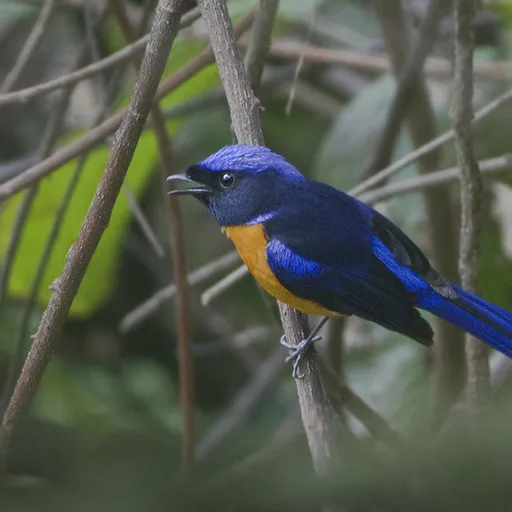
Rufous-bellied Niltava
Niltava sundara
Least Concern
Overview
The rufous-bellied niltava (Niltava sundara) is a species of flycatcher in the family Muscicapidae. Described by the English naturalist Brian Hodgson in 1837, it is one of six species in the genus Niltava found across South and Southeast Asia.
Identification
- Measuring 15–18 cm and weighing 19–24 g, it is a large, stocky and brightly coloured bird.
- Characterised by a rounded head shape, a fairly short tail, and a broad-based bill.
- Males display blue upperparts that can appear black in poor light, earning the bird alternative names such as the blue-and-orange niltava.
Habitat
This species inhabits subtropical or tropical moist lowland and montane forests. Its range spans Bangladesh, Bhutan, China, India, Laos, Myanmar, Nepal, Pakistan, Thailand, and Vietnam.
Diet
Predominantly insectivorous, the bird feeds mainly on small invertebrates and larvae, particularly ants and beetles, with occasional fruit. It forages by perching quietly in the undergrowth and darting out or dropping to the ground to catch prey.
Did you know?
The specific epithet sundara is a Latinised version of the Hindi word sundar, meaning 'beautiful'. The bird also goes by the common name orange-bellied niltava.
Sources
- Wikipedia · CC BY-SA 4.0
- Wikidata · CC0 1.0