
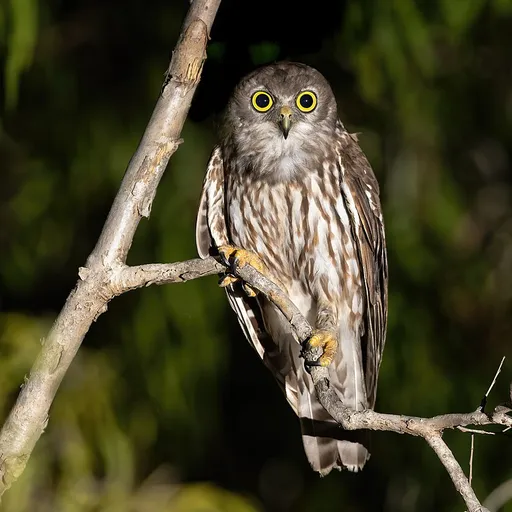
Barking Owl
Ninox connivens
Least Concern
Overview
The barking owl, or Ninox connivens, is a medium-sized nocturnal bird native to mainland Australia, New Guinea, and the Moluccas. It is also known by the alternative names barking boobook and winking owl.
Identification
- Coloured brown with white spots on the wings and a vertically streaked chest; underparts are brownish-grey with coarser white spotting.
- Large eyes with a yellow iris and a discrete facial mask, complemented by yellow skin on the feet.
- A robust bird measuring 39–44 cm in length with a wingspan of 85 to 120 cm.
- Characteristic vocalisations include a double 'hoot' resembling a small dog's bark, as well as intense howls and screams.
Habitat
Found in forests or woodlands with large trees for nesting and foliage cover for roosting, often near river, swamp, or creek beds. The species ranges across mainland Australia, particularly the eastern and northern coasts and the southwest, as well as drier parts of New Guinea and the Moluccas.
Diet
Possessing one of the broadest diets of any Australian owl, they hunt from perches in timbered and open habitats, consuming prey from the ground, trees, water surfaces, and the air. Their menu includes mammals, birds, insects, frogs, reptiles, fish, and crustaceans, effectively preying on any animal of their size or smaller that can be detected.
Did you know?
The barking owl's scream is described as sounding like a woman or child in pain, a noise that was historically credited to the mythical creature known as the bunyip. This 'screaming lady' sound is extremely rare, with many people hearing it only once in their lifetime even if they live next to a nest.
Sources
- Wikipedia · CC BY-SA 4.0
- Wikidata · CC0 1.0