
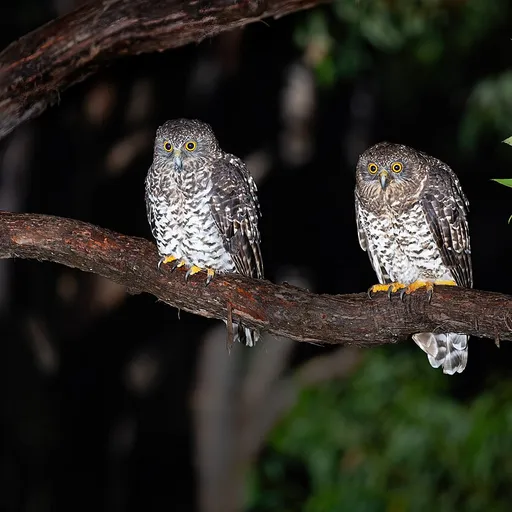
Powerful Owl
Ninox strenua
Least Concern
Overview
The powerful owl (Ninox strenua) is the largest owl on the Australian continent, acting as an apex predator in its narrow distribution. It is a territorial raptorial bird that maintains large home ranges and lives permanently in breeding pairs.
Identification
- Silhouette: Features a long tail and small head, imparting a distinctive hawk-like appearance enhanced by protruding bill and distinct brow ridges.
- Plumage: Upper parts are dark grey-brown and mottled with whitish barring; underparts are white with bold, grey-brown V-shaped bars.
- Size: Measures 45 to 65 cm in length with a wingspan of 112 to 135 cm; males are slightly larger and stronger than females.
- Song: The male produces a low, mournful, far-carrying double-hoot ('whoo-hooo'), where the second note is usually higher pitched than the first.
Habitat
Native to south-eastern and eastern Australia, the species ranges from Queensland to Victoria and western South Australia. It primarily inhabits tall, humid forests and coastal scrub, generally staying within 200 km of the coast, though it occasionally uses inland mountain slopes and plantations.
Diet
This nocturnal predator consumes approximately 75% arboreal mammals, including possums, gliders, and koalas, often taking prey that is significantly large relative to its own body weight. It forages by gliding from perch to perch to watch for activity, and also takes birds, introduced mammals, and occasionally insects, crayfish, or carrion.
Did you know?
Unlike most owl species where the female is larger and dominant, the male powerful owl is the larger and stronger sex, holding the dominant position in the mating pair and controlling food distribution. This male dominance is thought to enable the species to exhibit the rare behaviour of mantling over food while roosting during the day.
Sources
- Wikipedia · CC BY-SA 4.0
- Wikidata · CC0 1.0