
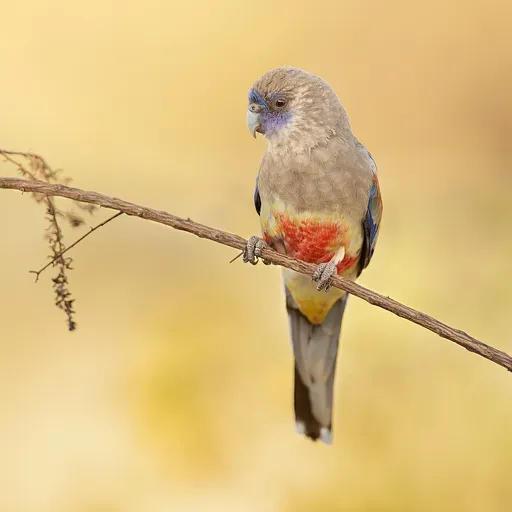
Eastern Bluebonnet
Northiella haematogaster
Least Concern
Overview
The eastern bluebonnet, also known as the greater bluebonnet, is a medium-sized inland Australian parrot belonging to the genus Northiella. It is a resident of arid and semi-arid regions and is classified as a species of Least Concern on the IUCN Red List.
Identification
- Mostly olive-grey to brown upper body with dark blue outer wings and a blue forehead and face.
- Prominent crest-like head feathers and a pearl-grey bill.
- Harsh 'chack chack' and loud 'yak-yak-yak' calls.
- No similar-looking species exist within its range.
Habitat
Inhabits arid and semi-arid zones in the interior of southeastern and central-southern Australia, ranging from northern Victoria to southern Queensland and southeast Western Australia. Favourable habitats include open woodlands of false sandalwood, mulga, and eucalyptus, often with a shrub layer of saltbush, as well as open grassy plains and mallee patches.
Diet
Feeds mostly on the ground on seeds from native and introduced grasses, herbaceous plants, trees, and shrubs. Also forages on fruit, berries, flowers, nectar, and insects, with saltbush seeds and fruit consumed in arid areas.
Did you know?
Although regarded as moderately common in the wild, the eastern bluebonnet is rarely kept in captivity due to its reputation for being drab, noisy, and extremely aggressive.
Sources
- Wikipedia · CC BY-SA 4.0
- Wikidata · CC0 1.0