
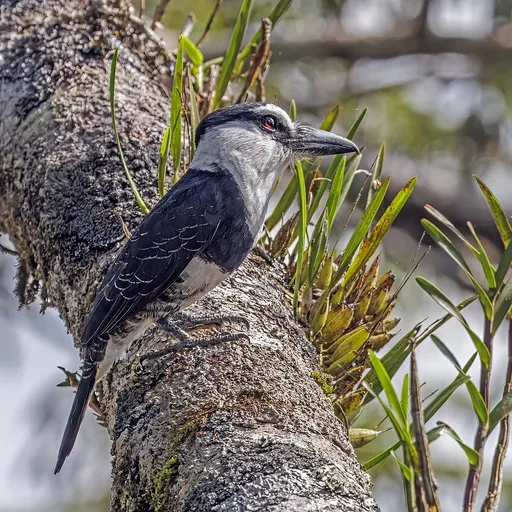
White-necked Puffbird
Notharchus hyperrhynchus
Least Concern
Listen
XC463772 · Oliver Komar · La Trinidad, Departamento de Comayagua, Honduras · CC BY-SA 4.0
Overview
The white-necked puffbird (Notharchus hyperrhynchus) is a species of bird in the family Bucconidae. It is a large, distinctive neotropical bird found across a vast range in the Americas. The species is currently classified as Least Concern by the IUCN Red List, although its population is believed to be decreasing.
Identification
- Approximately 25 cm long and weighing between 81 and 106 g, it is mostly glossy black with a very large black bill and black feet.
- Features a broad white forehead, throat, upper breast, and belly, separated by a broad black band, with white extending as a line around the nape.
- A black stripe runs from the beak to the crown, passing through a dark red eye, while the lower flanks are barred black and white and the tail has narrow white tips.
- Vocalisations include a long bubbling trill that rises slightly then falls, an evenly pitched monotonous trill lasting 3–5 seconds, a descending 'wheeew' whistle, and a quiet growl.
Habitat
The species is found in Mexico, Central America, and northern and western South America, including Colombia, Ecuador, Peru, Venezuela, Bolivia, and much of Amazonian Brazil. It inhabits a wide variety of semi-open environments such as secondary forest, forest edges, open woodlands, savannas, and clearings, as well as the interior of tropical evergreen and terra firme forests. It occurs at all levels of the forest from the ground to the canopy, typically ranging from sea level to 1,200 m in elevation.
Diet
Primarily insectivorous, it also consumes small invertebrates and some fruits. It forages by hunting from an open perch, diving on its prey, and will investigate army ant swarms. The bird beats its catch on the perch before eating it, and there is a single record of it capturing a rufous-tailed hummingbird.
Did you know?
The nesting behaviour involves both sexes excavating a cavity, usually in an arboreal termitarium or a rotting tree, with most nests located between 12 and 15 m above the ground. The one documented clutch consisted of only two eggs.
Sources
- Wikipedia · CC BY-SA 4.0
- Wikidata · CC0 1.0